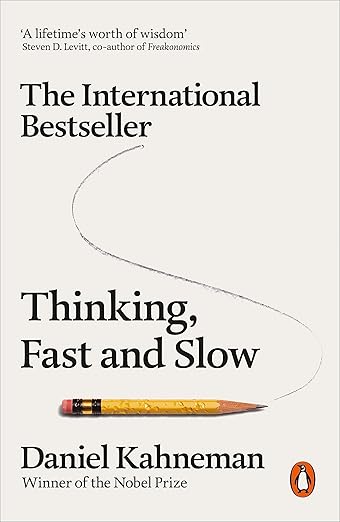


Thinking Fast and Slow
Daniel Kahneman – Biographical - NobelPrize.org
Thinking, Fast and Slow by Daniel Kahneman – Book Overview
Thinking, Fast and Slow by Daniel Kahneman explores how humans think, make decisions, and form judgments, often in ways they do not consciously realise. The book explains that much of what we believe to be rational decision-making is influenced by cognitive shortcuts, biases, and automatic reactions that operate beneath conscious awareness.
Drawing on decades of research in behavioural economics and psychology, Kahneman shows how intuition and deliberate reasoning interact, and why even experienced professionals regularly make predictable errors in judgment. The book is widely regarded as a foundational text for understanding decision-making in business, leadership, and everyday life.
For leaders, managers, and professionals, Thinking, Fast and Slow provides critical insight into why good intentions and intelligence alone are not enough to guarantee good decisions, particularly under pressure, uncertainty, or time constraints.
What Is Thinking, Fast and Slow About?
The Core Idea Explained Simply
The core idea of Thinking, Fast and Slow is that the human mind operates using two distinct modes of thinking. Daniel Kahneman refers to these as System 1 and System 2. System 1 is fast, automatic, emotional, and intuitive. It operates continuously and effortlessly, allowing people to make quick judgments, recognise patterns, and respond rapidly to their environment.
System 2, by contrast, is slow, deliberate, analytical, and effortful. It is responsible for complex reasoning, problem-solving, and conscious decision-making. While System 2 gives us the feeling of being in control, Kahneman demonstrates that it is often lazy, easily distracted, and reluctant to engage unless forced to do so.
Most everyday decisions are driven primarily by System 1. This is efficient and often effective, but it also introduces systematic errors. System 1 relies heavily on heuristics, or mental shortcuts, which simplify complex problems but can distort judgment. These shortcuts influence how people assess risk, interpret information, and evaluate outcomes.
Kahneman explains that cognitive biases are not random mistakes. They are predictable patterns of error that arise from the way the brain is wired. Examples include overconfidence, confirmation bias, anchoring, loss aversion, and availability bias. These biases affect decisions in finance, leadership, hiring, strategy, and personal life.
A key theme of the book is that confidence is often a poor indicator of accuracy. People frequently feel certain about judgments that are statistically unlikely or based on incomplete information. System 1 creates coherent stories quickly, even when the underlying data does not support them.
System 2 has the capacity to question these intuitive judgments, but it requires effort and attention. Under time pressure, fatigue, or stress, System 2 is less likely to intervene. As a result, flawed judgments often go unchallenged, particularly in fast-paced business environments.
The book also explores how humans evaluate outcomes rather than processes. People judge decisions based on results rather than the quality of reasoning that produced them. This leads to hindsight bias, where outcomes appear predictable after the fact, and learning is distorted.
Ultimately, Thinking, Fast and Slow is about awareness. It does not promise perfect decision-making, but it equips readers to recognise when their thinking may be unreliable and when slowing down is essential.
Who This Book Is For
This book is highly relevant for leaders, executives, managers, and professionals whose roles involve judgment, decision-making, and risk assessment. It is particularly valuable for those operating in complex, uncertain, or high-stakes environments.
Thinking, Fast and Slow is also suited to individuals involved in strategy, finance, sales, negotiations, hiring, or performance management, where cognitive bias can significantly influence outcomes.
Readers who are curious about why smart people make poor decisions, or who want to improve the quality of their thinking rather than simply their speed, will find this book especially useful.
Key Principles from Thinking, Fast and Slow
The Main Ideas or Frameworks
The central framework of the book is the distinction between System 1 and System 2 thinking. This model explains how intuition and reasoning interact and why intuition often dominates.
The book also introduces key concepts such as loss aversion, where losses feel more painful than equivalent gains feel rewarding, and prospect theory, which explains how people evaluate risk irrationally.
Why These Ideas Matter in Practice
These ideas matter because many business decisions are made under pressure, uncertainty, and incomplete information.
Understanding cognitive bias allows leaders to design better decision-making processes rather than relying on instinct alone.
Over time, this improves judgment quality and reduces avoidable errors.
How Thinking, Fast and Slow Applies to Business & Performance
Application in Leadership and Teams
In leadership contexts, the book highlights the importance of slowing down decisions that carry significant consequences.
This aligns closely with the disciplined judgment described in The Effective Executive, where decision quality matters more than speed.
Teams benefit when leaders encourage challenge, diverse perspectives, and structured decision reviews.
Application in Personal Performance and Discipline
At an individual level, the book encourages people to recognise when intuition may be misleading.
This complements the clarity-driven approach in Essentialism, where deliberate thinking replaces reactive behaviour.
Better thinking supports better performance.
Practical Examples and Real-World Application
Improving Decision Quality at Work
Organisations apply these ideas by introducing decision checklists, slowing down critical choices, and separating evaluation from outcome.
Leaders who normalise thoughtful challenge reduce bias.
Overcoming Common Thinking Errors
A common challenge is overconfidence.
The book encourages humility and structured reflection.
Strengths and Limitations of Thinking, Fast and Slow
What the Book Does Well
The book provides deep insight into how the mind works.
Its research foundation gives it lasting relevance.
Where It May Fall Short or Need Supplementing
The book is conceptually dense.
Pairing it with practical frameworks such as Good Strategy Bad Strategy helps translate insight into action.
How Thinking, Fast and Slow Compares to Similar Books
Compared to Principles, this book focuses more on cognitive mechanics. Compared to Atomic Habits, it addresses thinking rather than behaviour.
Why Business Coaches Recommend Thinking, Fast and Slow
Business coaches recommend this book because poor decisions often stem from invisible bias rather than lack of effort.
The work recognised by Daniel Kahneman reinforces the importance of disciplined thinking.
Should You Read Thinking, Fast and Slow?
Quick Decision Summary
This book is ideal for leaders seeking to improve judgment and decision quality.
Thinking, Fast and Slow – Frequently Asked Questions
What is Thinking, Fast and Slow really about?
The book explains how intuitive and deliberate thinking interact and why cognitive bias affects judgment.
Is this book relevant for business leaders?
Yes. Leaders make high-impact decisions under uncertainty.
Is the book difficult to read?
It is challenging but rewarding.
Does the book offer practical advice?
It focuses more on awareness than tactics.
Can this book improve performance?
Yes. Better thinking supports better decisions.
Is this book research-based?
Yes. It is grounded in decades of research.
Thinking, Fast and Slow – Key Takeaways
- Most thinking is automatic.
- Bias is predictable.
- Confidence does not equal accuracy.
- Slowing down improves decisions.
- Better thinking improves performance.