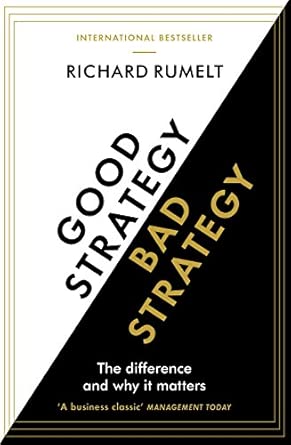


Good Strategy Bad Strategy
Rumelt | UCLA Anderson School of Management
Good Strategy Bad Strategy by Richard Rumelt – Book Overview
Good Strategy Bad Strategy by Richard Rumelt confronts one of the most common problems in business and leadership: the widespread confusion between real strategy and what Rumelt calls “bad strategy.” Drawing on decades of academic research and practical observation, the book explains why many organisations believe they have a strategy when, in reality, they are relying on vague goals, slogans, or aspirations that provide little guidance for action.
Rumelt argues that good strategy is not about vision statements, ambition, or inspirational language. It is about making clear choices in the face of challenge. Effective strategy identifies the critical problem, focuses effort on what matters most, and coordinates action toward a coherent response.
The book is especially relevant for leaders frustrated by plans that look impressive on paper but fail to translate into execution. It provides a clear framework for diagnosing problems and designing strategies that actually work.
What Is Good Strategy Bad Strategy About?
The Core Idea Explained Simply
The core idea of Good Strategy Bad Strategy is that most strategic failure comes from the absence of real strategy rather than poor execution. Richard Rumelt explains that many organisations confuse ambition with strategy. Statements such as “be the market leader” or “deliver excellence” may sound compelling, but they do not explain how to overcome obstacles or allocate resources.
Rumelt defines good strategy as a coherent set of choices designed to overcome a specific challenge. At the heart of good strategy is diagnosis. Leaders must clearly identify what is holding the organisation back, whether that is competitive pressure, internal capability gaps, market shifts, or operational constraints. Without diagnosis, effort becomes scattered.
The second element of good strategy is a guiding policy. This is the overall approach chosen to address the diagnosed challenge. It sets direction without descending into detailed plans. A strong guiding policy narrows options and creates focus.
The third element is coherent action. This involves aligning resources, decisions, and initiatives so they reinforce one another. Coherence ensures that actions work together rather than competing for attention or resources.
Rumelt contrasts this with bad strategy, which often appears in four forms. The first is fluff, language that sounds important but lacks substance. The second is failure to face the challenge, where leaders avoid acknowledging difficult realities. The third is mistaking goals for strategy. The fourth is bad strategic objectives that are unrealistic or disconnected from capabilities.
A recurring theme in the book is the importance of choice. Good strategy requires deciding what not to do. By concentrating effort on a small number of critical actions, organisations increase the likelihood of meaningful progress.
Ultimately, Good Strategy Bad Strategy reframes strategy as a discipline of focus, honesty, and decision-making rather than vision and ambition alone.
Who This Book Is For
This book is highly relevant for senior leaders, executives, and managers responsible for setting direction and allocating resources. It is particularly valuable for those who feel surrounded by activity but lack clarity about what truly matters.
Good Strategy Bad Strategy is also useful for professionals involved in planning, transformation, or performance improvement. Its frameworks help distinguish between productive effort and wasted motion.
Leaders who value clarity, accountability, and disciplined thinking will find the book especially practical.
Key Principles from Good Strategy Bad Strategy
The Main Ideas or Frameworks
The book centres on the kernel of good strategy: diagnosis, guiding policy, and coherent action. Rumelt also introduces concepts such as leverage, proximate objectives, and the importance of focusing on critical issues.
Another key idea is that strategy is problem-solving, not goal-setting.
Why These Ideas Matter in Practice
These ideas matter because unfocused effort wastes time and resources.
In practice, clear strategy improves alignment, decision-making, and execution.
How Good Strategy Bad Strategy Applies to Business & Performance
Application in Leadership and Teams
In leadership contexts, the book encourages leaders to confront reality honestly. Teams perform better when challenges are named clearly and priorities are explicit.
This focus on clarity aligns closely with the execution discipline described in Measure What Matters, where clear objectives drive performance.
Aligned teams act with confidence and purpose.
Application in Personal Performance and Discipline
At an individual level, the book encourages professionals to focus effort where it has the greatest impact. Clear priorities reduce overload.
This complements the focus-driven approach explored in Essentialism.
Practical Examples and Real-World Application
Diagnosing the Real Challenge
Organisations apply these ideas by stepping back from activity to identify root problems. This prevents reactive decision-making.
Clear diagnosis guides effective action.
Coordinating Action Effectively
A common challenge is fragmented initiatives.
The book emphasises alignment and coherence.
Strengths and Limitations of Good Strategy Bad Strategy
What the Book Does Well
The book offers a clear, practical definition of strategy. Its emphasis on diagnosis and focus is widely applicable.
Examples illustrate concepts effectively.
Where It May Fall Short or Need Supplementing
The book focuses more on strategy than culture.
Pairing it with leadership-focused frameworks such as The Advantage strengthens implementation.
How Good Strategy Bad Strategy Compares to Similar Books
Compared to vision-led strategy books, this work is more grounded and analytical. Compared to Playing to Win, it focuses more on diagnosis than competitive positioning.
Why Business Coaches Recommend Good Strategy Bad Strategy
Business coaches recommend this book because clarity and focus are prerequisites for performance.
The work associated with Richard Rumelt reinforces disciplined strategic thinking.
Should You Read Good Strategy Bad Strategy?
Quick Decision Summary
This book is ideal for leaders who want strategies that guide action rather than inspire briefly.
Good Strategy Bad Strategy – Frequently Asked Questions
What is Good Strategy Bad Strategy really about?
The book explains how real strategy focuses on diagnosing challenges and coordinating action rather than setting vague goals.
Is this book practical?
Yes. Its frameworks apply directly to real organisational challenges.
Does it apply to small organisations?
Yes. Strategy matters at any scale.
Is this book academic?
No. It is analytical but accessible.
Does it replace planning?
No. It improves planning quality.
Is this suitable for non-executives?
Yes. Anyone involved in decision-making benefits.
Good Strategy Bad Strategy – Key Takeaways
- Strategy is problem-solving.
- Diagnosis precedes action.
- Focus increases impact.
- Coherence drives execution.
- Clarity supports performance.