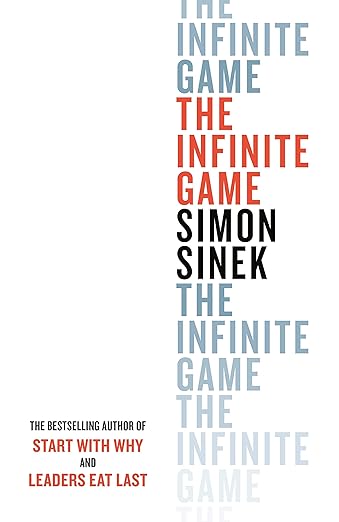


The Infinite Game
Leadership Training & Employee Development Platform - The Optimism Company
The Infinite Game by Simon Sinek – Book Overview
The Infinite Game by Simon Sinek explores how leaders, organisations, and individuals should think about success when the objective is not to win, but to endure. The book challenges many traditional assumptions about competition, performance, and strategy by arguing that most business and leadership environments are not finite games with clear winners and losers.
Instead, Sinek proposes that business, leadership, and life itself operate as infinite games. In these environments, there is no finish line, no fixed set of players, and no definitive victory. Performance, therefore, must be measured differently, focusing on longevity, adaptability, and resilience rather than short-term outcomes.
The Infinite Game is particularly relevant for leaders navigating uncertainty, disruption, and long-term responsibility. It reframes performance as something that must be sustained, not maximised in bursts.
What Is The Infinite Game About?
The Core Idea Explained Simply
At its core, The Infinite Game is about shifting perspective. Simon Sinek draws on the work of philosopher James P. Carse to distinguish between finite and infinite games. Finite games are played with known players, fixed rules, and a clear endpoint. The objective is to win.
Infinite games, by contrast, have changing players, evolving rules, and no finish line. The objective is to continue playing. Sinek argues that most leaders mistakenly apply finite-game thinking to infinite environments such as business, politics, and leadership.
When leaders adopt a finite mindset, they prioritise short-term metrics, beating competitors, and quick wins. This often leads to decisions that undermine trust, culture, and long-term performance. Cost-cutting, burnout, ethical compromise, and short-term optimisation become common.
The book introduces the concept of an infinite mindset. Leaders with an infinite mindset focus on advancing a just cause, building trusting teams, embracing worthy rivals, preparing for existential flexibility, and demonstrating the courage to lead.
A just cause is a clear, compelling reason for an organisation’s existence beyond profit. It provides direction and meaning, helping people understand why their work matters.
Trusting teams are built through consistency, fairness, and psychological safety. When people feel safe, they perform better and adapt more effectively.
Worthy rivals are competitors who reveal areas for improvement rather than enemies to defeat. Learning replaces obsession with winning.
Existential flexibility allows organisations to adapt when circumstances change dramatically, even if it means sacrificing short-term advantage.
Ultimately, the book argues that sustainable performance depends on thinking beyond quarterly results and embracing responsibility for long-term impact.
Who This Book Is For
This book is particularly valuable for senior leaders, executives, and business owners responsible for long-term outcomes. It is also relevant for professionals seeking meaning and stability in uncertain environments.
It resonates strongly with those who feel pressure to prioritise short-term results at the expense of culture, ethics, or wellbeing.
Key Principles from The Infinite Game
The Main Ideas or Frameworks
The central framework of the book is the infinite mindset. This mindset prioritises longevity over dominance and progress over victory.
The five practices of the infinite mindset provide a practical structure: advancing a just cause, building trusting teams, studying worthy rivals, preparing for existential flexibility, and leading with courage.
These practices guide decision-making when outcomes are uncertain and timelines are long.
Why These Ideas Matter in Practice
These ideas matter because many organisations suffer from short-termism. Decisions made to satisfy immediate metrics often damage long-term capability.
In practice, adopting an infinite mindset helps leaders balance performance with sustainability.
Over time, this approach supports resilience, trust, and consistent results.
How The Infinite Game Applies to Business & Performance
Application in Leadership and Teams
In leadership contexts, the infinite mindset encourages leaders to think beyond targets and rankings. It emphasises responsibility for people, culture, and long-term health.
This aligns closely with the trust-based leadership explored in Leaders Eat Last, where performance emerges from safety and belonging.
Teams led with an infinite mindset are more adaptable, engaged, and resilient under pressure.
Application in Personal Performance and Discipline
At an individual level, infinite thinking reduces anxiety around comparison and competition. Progress becomes more important than position.
This complements consistency-driven approaches such as Atomic Habits, where long-term improvement matters more than short-term outcomes.
Individuals who adopt this mindset sustain performance without burnout.
Practical Examples and Real-World Application
Building Habits or Skills in a Business Environment
Organisations apply infinite thinking by investing in people development, ethical standards, and adaptability.
Leaders reinforce this mindset through decision-making that prioritises trust and capability over immediate gain.
Over time, these habits strengthen long-term performance.
Overcoming Common Challenges in Practice
A common challenge is pressure from short-term metrics. Leaders may struggle to justify long-term decisions.
The book encourages leaders to communicate clearly about purpose and direction.
This clarity helps organisations stay aligned during uncertainty.
Strengths and Limitations of The Infinite Game
What the Book Does Well
The book excels at reframing competition and success. Its concepts are simple yet powerful.
It provides language and structure for long-term leadership thinking.
Where It May Fall Short or Need Supplementing
The book is philosophical rather than tactical.
Pairing it with execution-focused frameworks such as Good Strategy Bad Strategy helps translate mindset into action.
How The Infinite Game Compares to Similar Books
Compared to Start With Why, The Infinite Game focuses less on purpose alone and more on long-term behaviour. Compared to Good to Great, it emphasises endurance over performance transition.
Why Business Coaches Recommend The Infinite Game
Business coaches recommend The Infinite Game because it helps leaders escape short-term thinking.
The work supported by The Optimism Company reinforces the importance of trust, purpose, and long-term responsibility.
When applied consistently, these principles support sustainable performance.
Should You Read The Infinite Game?
Quick Decision Summary
This book is ideal for leaders seeking long-term clarity, resilience, and ethical performance.
It may feel abstract for readers focused solely on short-term tactics.
The Infinite Game – Frequently Asked Questions
What is The Infinite Game really about?
The book explains how leadership and business operate as infinite games where the goal is to endure, adapt, and progress rather than win.
Is The Infinite Game relevant for business leaders?
Yes. It helps leaders balance performance with long-term responsibility.
Does the book reject competition?
No. It reframes competition as learning from worthy rivals rather than defeating enemies.
Is The Infinite Game practical?
It is conceptual but provides clear principles for decision-making.
Can individuals apply infinite thinking?
Yes. Individuals can focus on progress, learning, and sustainability.
Is this book suitable for senior leaders?
Yes. It is particularly relevant for executives shaping long-term direction.
The Infinite Game – Key Takeaways
- Business is an infinite game.
- Long-term thinking matters.
- Trust enables endurance.
- Purpose guides decisions.
- Sustainability beats short-term wins.