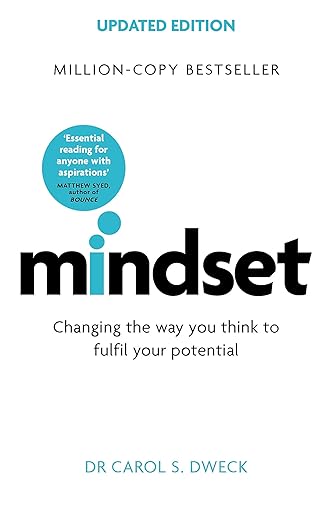


Mindset
Carol Dweck
Mindset by Carol S. Dweck – Book Overview
Mindset by Carol S. Dweck explores how deeply held beliefs about ability, intelligence, and success shape behaviour, performance, and long-term outcomes. Rather than focusing on talent or personality, the book examines how the way people interpret challenge, failure, and effort determines their capacity to grow and improve.
The book introduces two contrasting ways of thinking: the fixed mindset and the growth mindset. These mindsets influence how people respond to feedback, setbacks, and pressure. In business, leadership, and personal performance, these responses often determine whether individuals stagnate or continue to develop.
Mindset has become a foundational text in education, leadership, and performance development because it explains why capability alone is not enough. Sustainable performance depends on how people interpret difficulty and whether they see effort as a weakness or a pathway to improvement.
What Is Mindset About?
The Core Idea Explained Simply
The core idea of Mindset is that beliefs about ability shape behaviour. People with a fixed mindset believe that intelligence and talent are static. They tend to avoid challenge, resist feedback, and view effort as a sign of inadequacy.
In contrast, people with a growth mindset believe that ability can be developed through effort, learning, and persistence. They are more willing to take on challenges, learn from mistakes, and remain engaged when progress is slow.
This distinction explains why two people with similar capability can experience very different outcomes over time. The mindset they adopt determines how they respond to pressure, setbacks, and opportunity.
Who This Book Is For
This book is highly relevant for leaders, managers, educators, and professionals responsible for developing themselves or others. It is particularly valuable for anyone working in environments where learning, adaptability, and performance improvement are essential.
It is also useful for individuals who feel limited by self-doubt, fear of failure, or inconsistent confidence despite proven ability.
Key Principles from Mindset
The Main Ideas or Frameworks
The central framework in Mindset is the distinction between fixed and growth mindsets. A fixed mindset interprets success as validation of talent and failure as evidence of limitation. A growth mindset interprets success as progress and failure as information.
The book also explains how praise, feedback, and leadership behaviour can reinforce either mindset. Praising intelligence or talent tends to reinforce fixed thinking, while praising effort, strategy, and persistence supports growth.
Another important idea is that mindset is not permanent. People can shift their thinking through awareness, reflection, and deliberate practice.
Why These Ideas Matter in Practice
These ideas matter because mindset influences behaviour under pressure. In fixed-mindset environments, people hide mistakes, avoid risk, and protect reputation.
In growth-oriented environments, people engage more openly with feedback, learn faster, and recover more quickly from setbacks.
Over time, these differences have a significant impact on performance, innovation, and resilience.
How Mindset Applies to Business & Performance
Application in Leadership and Teams
In leadership contexts, mindset shapes how leaders respond to underperformance. Fixed-mindset leaders may label people as capable or incapable, limiting development.
Growth-oriented leaders focus on coaching, learning, and improvement. This aligns closely with the accountability-focused approach in High Performance: The Quiet Work That Changes Everything, where clarity and development support consistent results.
Teams led with a growth mindset are more likely to collaborate, share learning, and maintain standards during challenge.
Application in Personal Performance and Discipline
At an individual level, mindset affects how people respond to difficulty. A fixed mindset often leads to avoidance or disengagement when progress slows.
A growth mindset supports persistence, reflection, and adjustment. This complements habit-based approaches such as Atomic Habits, where small improvements accumulate over time.
By reframing effort as progress rather than failure, individuals sustain performance without burnout.
Practical Examples and Real-World Application
Building Habits or Skills in a Business Environment
In business environments, growth mindset is reinforced through how learning is approached. Leaders who normalise experimentation and reflection encourage skill development.
Clear expectations combined with supportive feedback help people stretch capability while maintaining accountability.
Over time, this approach builds competence, confidence, and consistency.
Overcoming Common Challenges in Practice
A common challenge is misunderstanding growth mindset as leniency. Growth does not mean lowering standards.
The book emphasises that high expectations paired with learning-focused feedback drive the strongest outcomes.
This balance supports both performance and development.
Strengths and Limitations of Mindset
What the Book Does Well
Mindset excels at explaining complex psychological concepts in accessible language. The ideas are easy to understand and widely applicable.
Its focus on learning, effort, and development provides a strong foundation for long-term performance improvement.
Where It May Fall Short or Need Supplementing
The book focuses more on psychological framing than execution systems.
Pairing it with structured performance frameworks such as Good to Great helps translate mindset into consistent results.
How Mindset Compares to Similar Books
Compared to Atomic Habits, Mindset focuses more on belief systems than behaviour design. Compared to High Performance: The Quiet Work That Changes Everything, it emphasises internal interpretation rather than external structure.
Together, these perspectives create a complete view of sustainable performance.
Why Business Coaches Recommend Mindset
Business coaches frequently recommend Mindset because performance issues often stem from fear of failure rather than lack of skill.
The research-led work of Carol Dweck helps leaders and individuals reframe challenge as an opportunity for development.
When applied consistently, these ideas support learning cultures, resilience, and long-term improvement.
Should You Read Mindset?
Quick Decision Summary
This book is ideal for leaders and professionals seeking to improve learning, adaptability, and resilience.
It may be less suitable for readers looking for tactical productivity tools.
Mindset – Frequently Asked Questions
What is Mindset really about?
Mindset explains how beliefs about ability influence behaviour, learning, and performance. It shows that people who view ability as developable are more resilient, engaged, and capable of long-term improvement.
Is Mindset useful for business leaders?
Yes. Business leaders use Mindset to shape learning cultures, improve feedback, and support development without lowering standards.
Does Mindset mean everyone can achieve anything?
No. The book does not claim unlimited potential. It argues that improvement is possible through effort, learning, and strategy.
Can mindset really be changed?
Yes. The book explains that awareness and deliberate practice can shift thinking patterns over time.
Is Mindset evidence-based?
Yes. The ideas are grounded in decades of psychological research and studies.
Is Mindset relevant for individuals?
Yes. Individuals apply growth mindset principles to learning, confidence, and performance challenges.
Mindset – Key Takeaways
- Beliefs shape behaviour.
- Effort supports development.
- Failure provides information.
- Learning drives performance.
- Growth requires consistency.