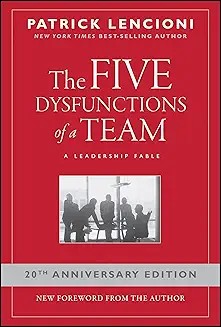


The Five Dysfunctions of a Team
Meet Patrick Lencioni | The Table Group
The Five Dysfunctions of a Team by Patrick Lencioni – Book Overview
The Five Dysfunctions of a Team by Patrick Lencioni examines why teams fail to perform at their best, even when they are made up of capable, intelligent, and motivated individuals. Rather than focusing on strategy, structure, or incentives, the book looks at the human behaviours and relationships that determine whether teams succeed or struggle.
Written as a leadership fable, the book follows a fictional executive team as it confronts internal conflict, poor communication, and declining performance. Through this narrative, Lencioni introduces a practical model that explains how dysfunctions build on one another and how leaders can address them.
The book has become a staple in leadership development because it addresses problems that are common, uncomfortable, and often avoided. Its value lies in its simplicity and its direct relevance to real-world teams.
What Is The Five Dysfunctions of a Team About?
The Core Idea Explained Simply
At its core, The Five Dysfunctions of a Team is about trust and behaviour. Lencioni argues that team performance breaks down not because people lack skill or intelligence, but because they fail to build the relational foundations required for effective collaboration.
The book introduces a pyramid model made up of five dysfunctions. At the base is absence of trust, which occurs when team members are unwilling to be vulnerable with one another. Without trust, people hide mistakes, avoid asking for help, and protect themselves rather than the team.
When trust is missing, teams fear conflict. Healthy debate is replaced by artificial harmony, where important issues are avoided to maintain comfort. This leads to poor decision-making and unresolved tension.
The next dysfunction is lack of commitment. When teams avoid conflict, decisions lack buy-in. People leave meetings unclear or privately disagreeing, which undermines execution.
This leads to avoidance of accountability. Without commitment, team members hesitate to challenge one another on standards or behaviour. Performance expectations weaken, and inconsistency becomes normal.
At the top of the pyramid is inattention to results. When accountability is low, individuals prioritise personal success, status, or departmental goals over collective outcomes. Team performance suffers as a result.
Lencioni’s central message is that these dysfunctions are interrelated and cumulative. Teams cannot address surface-level issues without first building trust at the foundation.
Who This Book Is For
This book is especially relevant for leaders, managers, and team members working in collaborative environments. It is valuable for anyone responsible for leading groups, projects, or organisations where results depend on collective effort.
It is also highly applicable to leadership teams, where unresolved tension and lack of trust often have disproportionate impact.
Key Principles from The Five Dysfunctions of a Team
The Main Ideas or Frameworks
The central framework of the book is the five dysfunctions pyramid. Each dysfunction builds on the one below it, meaning teams must address issues in the correct order.
Lencioni emphasises vulnerability-based trust as the foundation. This type of trust allows people to admit mistakes, ask for help, and engage honestly.
The model also reinforces the importance of healthy conflict, clear commitment, peer accountability, and a relentless focus on results.
Why These Ideas Matter in Practice
These ideas matter because many teams attempt to improve performance through tools or processes while ignoring behaviour.
In practice, addressing dysfunctions improves communication, clarity, and execution without adding complexity.
Over time, teams that address these issues perform more consistently and with less friction.
How The Five Dysfunctions of a Team Applies to Business & Performance
Application in Leadership and Teams
In leadership contexts, the book highlights the leader’s role in modelling vulnerability and setting behavioural standards.
This aligns closely with the accountability-driven leadership described in Extreme Ownership, where leaders take responsibility for team culture and performance.
Leaders who address dysfunctions directly create teams that are more resilient, aligned, and results-focused.
Application in Personal Performance and Discipline
At an individual level, the book encourages professionals to prioritise team success over ego or self-protection.
This perspective complements the clarity and standards discussed in High Performance: The Quiet Work That Changes Everything.
Individuals who adopt this mindset contribute more effectively to team outcomes.
Practical Examples and Real-World Application
Building Habits or Skills in a Business Environment
Teams apply the model through regular open discussion, clear commitments, and peer-to-peer feedback.
Leaders reinforce behaviour by addressing issues quickly and consistently.
Over time, these habits normalise accountability and trust.
Overcoming Common Challenges in Practice
A common challenge is discomfort. Vulnerability and conflict feel risky.
The book emphasises that avoiding discomfort leads to greater dysfunction later.
Leaders must hold the line on behaviour to sustain improvement.
Strengths and Limitations of The Five Dysfunctions of a Team
What the Book Does Well
The book’s greatest strength is its simplicity. The model is easy to understand and remember.
Its focus on behaviour rather than tools makes it widely applicable.
Where It May Fall Short or Need Supplementing
The book focuses on team behaviour rather than operational systems.
Pairing it with performance-focused frameworks such as Good to Great can strengthen execution.
How The Five Dysfunctions of a Team Compares to Similar Books
Compared to Extreme Ownership, this book focuses more on collective behaviour than individual responsibility. Compared to Leaders Eat Last, it emphasises accountability alongside trust.
Why Business Coaches Recommend The Five Dysfunctions of a Team
Business coaches recommend this book because it addresses issues that most teams experience but rarely name.
The work of The Table Group continues to support leaders in applying these principles effectively.
When applied consistently, the model improves trust, clarity, and performance.
Should You Read The Five Dysfunctions of a Team?
Quick Decision Summary
This book is ideal for leaders and teams seeking to improve trust, communication, and collective results.
It may feel confronting for teams unwilling to address behaviour openly.
The Five Dysfunctions of a Team – Frequently Asked Questions
What is The Five Dysfunctions of a Team really about?
The book explains how trust, conflict, commitment, accountability, and results determine team effectiveness. It shows that performance problems often stem from behaviour rather than capability.
Is this book suitable for leadership teams?
Yes. It is especially relevant for executive and senior leadership teams.
Does the book provide practical tools?
Yes. The model is practical and widely used in leadership development.
Is the fable format effective?
Yes. The narrative makes the lessons relatable and memorable.
Can individuals apply the ideas?
Yes. Individuals can improve how they contribute to teams by applying the principles.
Is this book evidence-based?
The model is based on extensive leadership consulting experience rather than academic research.
The Five Dysfunctions of a Team – Key Takeaways
- Trust is the foundation of teamwork.
- Healthy conflict improves decisions.
- Commitment drives execution.
- Accountability maintains standards.
- Results require collective focus.