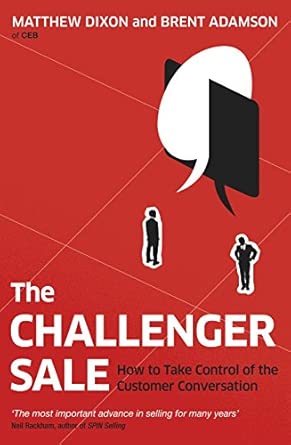


The Challenger Sale
About Brent — Brent Adamson
The Challenger Sale by Matthew Dixon & Brent Adamson – Book Overview
The Challenger Sale by Matthew Dixon and Brent Adamson challenges many traditional assumptions about what drives success in complex sales environments. Based on extensive research into thousands of sales professionals, the book argues that top performers do not win primarily through relationships, persistence, or technical expertise alone. Instead, they succeed by teaching customers new perspectives, tailoring insight to the customer’s context, and taking control of the sales conversation.
The book is particularly relevant in business-to-business environments where decisions are complex, multiple stakeholders are involved, and buyers are already well informed. In these settings, customers are not looking for product information alone. They are looking for clarity, guidance, and confidence in decision-making.
The Challenger Sale reframes selling as a performance discipline rooted in insight, commercial understanding, and disciplined execution rather than charisma or relationship management.
What Is The Challenger Sale About?
The Core Idea Explained Simply
The core idea of The Challenger Sale is that the most effective salespeople challenge their customers’ thinking. Rather than asking broad discovery questions and reacting to stated needs, challengers lead with insight. They reframe how customers see their problems, opportunities, and risks.
Dixon and Adamson identify five distinct sales profiles: the Relationship Builder, the Hard Worker, the Lone Wolf, the Reactive Problem Solver, and the Challenger. While each profile has strengths, the research shows that Challengers consistently outperform others in complex sales environments.
Challengers succeed because they combine three critical behaviours. First, they teach customers something valuable about their business. This insight is not product-focused, but commercially relevant, often highlighting hidden costs, risks, or missed opportunities. Second, they tailor their message to resonate with different stakeholders, recognising that finance, operations, and leadership care about different outcomes. Third, they take control of the sale by confidently guiding the conversation around price, value, and decision-making.
The book challenges the idea that customers always know what they need. In reality, many buyers struggle to connect their problems to viable solutions. Challengers bridge this gap by bringing clarity, structure, and perspective.
A key theme is constructive tension. Challengers are comfortable pushing back, questioning assumptions, and reframing priorities. This is not confrontational behaviour, but purposeful leadership in the conversation. By introducing tension early, challengers avoid price pressure later.
The book also emphasises discipline. Challenger selling is not improvised. It requires preparation, commercial understanding, and a clear point of view about how the customer should change.
Ultimately, The Challenger Sale positions selling as a form of leadership. The salesperson who creates clarity and confidence becomes indispensable to the buying decision.
Who This Book Is For
This book is highly relevant for sales professionals operating in complex, consultative, or high-value sales environments. It is particularly useful for those selling solutions rather than simple products.
Sales leaders and managers will also benefit, as the book provides insight into how to develop capability, coach performance, and design sales processes that support consistent execution.
The Challenger Sale is equally valuable for business leaders who want to understand how buying decisions are influenced and how value is communicated effectively.
Key Principles from The Challenger Sale
The Main Ideas or Frameworks
The book introduces the Teach–Tailor–Take Control framework as the foundation of Challenger selling. This framework provides a clear structure for leading sales conversations with insight and authority.
It also introduces the concept of commercial teaching, where insight is used to shift customer priorities rather than simply validate existing beliefs.
Why These Ideas Matter in Practice
These ideas matter because traditional relationship-based selling often fails in complex environments.
In practice, customers respond to clarity, confidence, and insight.
How The Challenger Sale Applies to Business & Performance
Application in Leadership and Teams
For sales leaders, The Challenger Sale highlights the importance of setting standards around message quality, preparation, and customer insight. High-performing teams do not rely on individual heroics.
This emphasis on standards and accountability aligns closely with the principles outlined in Good Strategy Bad Strategy, where focus and diagnosis drive effective action.
Teams that adopt challenger behaviours operate with greater confidence and consistency.
Application in Personal Performance and Discipline
At an individual level, Challenger selling requires discipline. Preparation replaces improvisation, and insight replaces activity.
This mirrors the performance mindset explored in High Performance Habits, where clarity and intentional action drive results.
Practical Examples and Real-World Application
Using Insight to Lead Sales Conversations
In practice, challengers lead with insight that reframes customer priorities.
This might involve highlighting hidden costs, inefficiencies, or risks the customer has underestimated.
Handling Price and Resistance
Challengers address price confidently by anchoring value early.
By taking control of the conversation, they reduce late-stage resistance.
Strengths and Limitations of The Challenger Sale
What the Book Does Well
The book is strongly research-based and grounded in real-world data.
Its frameworks are clear and applicable.
Where It May Fall Short or Need Supplementing
The book focuses primarily on sales rather than broader leadership behaviour.
Pairing it with coaching-focused frameworks such as The Coaching Habit supports skill development.
How The Challenger Sale Compares to Similar Books
Compared to relationship-based sales models, The Challenger Sale prioritises insight over rapport. Compared to You Can’t Teach a Kid to Ride a Bike at a Seminar, it focuses more on mindset and message than technique alone.
Why Business Coaches Recommend The Challenger Sale
Business coaches recommend The Challenger Sale because it reinforces clarity, confidence, and accountability in performance.
The research associated with Brent Adamson highlights how insight-driven conversations change outcomes.
Should You Read The Challenger Sale?
Quick Decision Summary
This book is ideal for professionals selling complex solutions and leaders responsible for sales performance.
The Challenger Sale – Frequently Asked Questions
What is The Challenger Sale really about?
The book explains how leading customers with insight improves sales performance in complex environments.
Is this approach confrontational?
No. It is assertive and value-led, not aggressive.
Does it replace relationship selling?
No. It reframes relationships around insight.
Is it suitable for modern buyers?
Yes. Informed buyers value guidance.
Can sales teams be trained to be challengers?
Yes. Challenger behaviours can be developed.
Does it apply outside sales?
Yes. Insight-led influence applies broadly.
The Challenger Sale – Key Takeaways
- Insight drives modern selling.
- Challengers lead customer thinking.
- Clarity reduces price pressure.
- Discipline beats improvisation.
- Standards improve consistency.