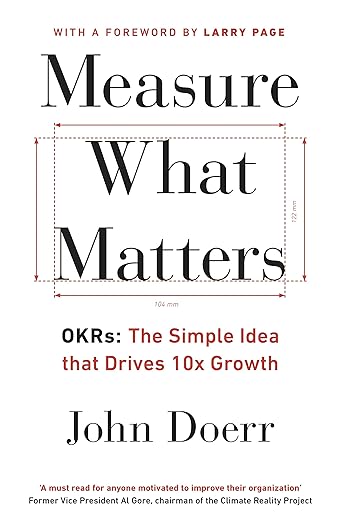


Measure What Matters
John Doerr - Kleiner Perkins
Measure What Matters by John Doerr – Book Overview
Measure What Matters by John Doerr explains how organisations and individuals can achieve focus, alignment, and execution through clear goal-setting and disciplined measurement. The book introduces Objectives and Key Results, commonly known as OKRs, as a practical framework for translating ambition into action while maintaining clarity and accountability.
Drawing on Doerr’s experience working with some of the world’s most successful organisations, the book shows how poorly defined goals, vague priorities, and misaligned incentives undermine performance. Measure What Matters argues that what gets measured, discussed, and reviewed consistently is what ultimately drives behaviour and results.
The book is especially relevant in environments where growth, complexity, and scale create confusion. It positions measurement not as bureaucracy, but as a leadership tool that enables clarity, focus, and sustained performance.
What Is Measure What Matters About?
The Core Idea Explained Simply
The central idea of Measure What Matters is that ambition without measurement is ineffective. John Doerr argues that many organisations have inspiring visions but lack the structure required to turn those aspirations into consistent execution. OKRs provide a simple yet powerful way to bridge that gap.
An objective defines what you want to achieve. It should be clear, meaningful, and direction-setting. Key results define how you know whether you are making progress. They are specific, measurable, and time-bound. Together, objectives and key results create focus and transparency.
The book explains that OKRs are not about micromanagement. Instead, they are designed to encourage alignment while preserving autonomy. Teams understand what matters most, but retain flexibility in how they achieve it. This balance between clarity and freedom supports both accountability and innovation.
A recurring theme in the book is the importance of focus. Doerr emphasises that effective OKR systems limit the number of objectives in play at any given time. When too many priorities compete for attention, none receive sufficient energy. Measurement forces difficult conversations about what truly matters.
The book also addresses the role of transparency. When goals and progress are visible, accountability increases naturally. People understand how their work contributes to wider objectives, and conversations shift from activity to impact.
Doerr highlights the importance of cadence. OKRs are not set and forgotten. They are reviewed regularly, discussed openly, and adjusted when necessary. This rhythm creates learning loops that improve execution over time.
Another key insight is that OKRs separate goals from compensation. By decoupling performance measurement from reward, organisations encourage ambition rather than risk avoidance. Stretch goals become possible because failure is treated as learning rather than punishment.
Ultimately, Measure What Matters reframes measurement as a leadership discipline. When leaders measure what truly matters, behaviour aligns, effort focuses, and performance improves sustainably.
Who This Book Is For
This book is highly relevant for leaders, executives, managers, and founders responsible for setting direction and driving execution. It is particularly valuable for organisations experiencing growth, change, or increasing complexity.
Measure What Matters is also well suited to teams that struggle with alignment. When people are busy but unsure whether their work contributes to shared goals, OKRs provide clarity and purpose.
Individuals seeking to improve personal performance will also benefit. The principles of clear objectives, measurable progress, and regular review apply at an individual level as effectively as they do organisationally.
Key Principles from Measure What Matters
The Main Ideas or Frameworks
The core framework of the book is OKRs. This includes setting ambitious objectives, defining measurable key results, maintaining transparency, and reviewing progress regularly.
The book also emphasises focus, alignment, commitment, tracking, and stretching as essential elements of effective goal systems.
Why These Ideas Matter in Practice
These ideas matter because unclear goals lead to wasted effort.
In practice, clear measurement improves decision-making, prioritisation, and accountability.
How Measure What Matters Applies to Business & Performance
Application in Leadership and Teams
In leadership contexts, Measure What Matters encourages leaders to be explicit about priorities. Teams perform better when they know what success looks like and how it will be assessed.
This aligns closely with the clarity and standards described in Essentialism, where focus is protected deliberately.
Aligned teams move faster and with greater confidence.
Application in Personal Performance and Discipline
At an individual level, OKRs help people move from vague intention to specific action.
This complements the execution discipline explored in The Effective Executive.
Measurement supports sustained progress.
Practical Examples and Real-World Application
Using OKRs to Drive Execution
Organisations apply OKRs by limiting objectives, defining measurable outcomes, and reviewing progress regularly.
Leaders reinforce the system by discussing results openly.
Overcoming Common Measurement Challenges
A common challenge is overcomplicating metrics.
The book encourages simplicity and relevance.
Strengths and Limitations of Measure What Matters
What the Book Does Well
The book provides a clear, practical framework for aligning ambition with execution.
Its real-world examples reinforce credibility.
Where It May Fall Short or Need Supplementing
The book focuses heavily on goals rather than behaviour.
Pairing it with habit-focused frameworks such as Atomic Habits strengthens application.
How Measure What Matters Compares to Similar Books
Compared to Good Strategy Bad Strategy, this book focuses more on execution than diagnosis. Compared to High Performance Habits, it emphasises measurement over mindset.
Why Business Coaches Recommend Measure What Matters
Business coaches recommend this book because clarity and accountability are prerequisites for performance.
The work associated with John Doerr reinforces the importance of measuring what truly matters.
Should You Read Measure What Matters?
Quick Decision Summary
This book is ideal for leaders and teams seeking alignment, focus, and disciplined execution.
Measure What Matters – Frequently Asked Questions
What is Measure What Matters really about?
The book explains how OKRs help translate ambition into measurable execution through clarity, alignment, and accountability.
Is this book suitable for leaders?
Yes. Leaders use OKRs to align teams and drive focus.
Does it apply to small organisations?
Yes. OKRs scale effectively.
Is the book practical?
Yes. It focuses on applied goal-setting.
Can individuals use OKRs?
Yes. Individuals can set personal OKRs.
Does measurement limit creativity?
No. It supports focus and learning.
Measure What Matters – Key Takeaways
- Clear goals drive execution.
- Measurement creates accountability.
- Focus improves results.
- Transparency builds alignment.
- Progress requires review.