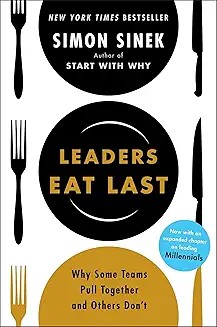


Leaders Eat Last
Leadership Training & Employee Development Platform - The Optimism Company
Leaders Eat Last by Simon Sinek – Book Overview
Leaders Eat Last by Simon Sinek explores what creates strong, resilient teams and why some organisations consistently outperform others through trust, loyalty, and cooperation. Rather than focusing on strategy, targets, or incentives, the book examines the human environment that enables people to perform well over the long term.
The central premise is that leadership is not defined by authority or position, but by responsibility for others. When leaders prioritise the wellbeing of their people, teams become more committed, adaptable, and willing to give discretionary effort. Performance, in this context, is a by-product of trust rather than pressure.
Drawing on biology, psychology, and real-world case studies, the book offers a compelling argument for why cultures built on safety and belonging outperform those driven purely by metrics and control.
What Is Leaders Eat Last About?
The Core Idea Explained Simply
The core idea of Leaders Eat Last is that great leadership creates an environment where people feel safe, valued, and supported. When individuals trust that their leaders have their best interests at heart, they are more likely to collaborate, take responsibility, and perform consistently.
Sinek explains this through the concept of the “Circle of Safety.” Inside this circle, people feel protected from internal threats such as politics, blame, or uncertainty. Outside threats can then be faced together with confidence.
This approach reframes leadership as stewardship. Leaders succeed by creating conditions where others can do their best work.
Who This Book Is For
This book is particularly relevant for leaders, managers, and professionals responsible for team performance, engagement, and retention. It is also valuable for organisations seeking to build cultures that support long-term success rather than short-term output.
It resonates strongly with those who recognise that performance issues often stem from culture and trust rather than skill gaps.
Key Principles from Leaders Eat Last
The Main Ideas or Frameworks
A central idea in the book is the role of biology in behaviour. Sinek explains how chemicals such as oxytocin, serotonin, and cortisol influence trust, cooperation, and stress. Leaders who create safe environments reduce chronic stress and enable better decision-making.
Another key principle is service-based leadership. Leaders are expected to sacrifice personal comfort for the benefit of the group, setting an example that reinforces trust and loyalty.
The book also highlights the importance of consistency. Trust is built through repeated behaviours rather than isolated gestures.
Why These Ideas Matter in Practice
These ideas matter because fear-based cultures suppress performance. When people feel threatened internally, they focus on self-protection rather than contribution.
In practice, creating psychological safety improves collaboration, problem-solving, and accountability.
Over time, this environment supports sustainable performance rather than burnout.
How Leaders Eat Last Applies to Business & Performance
Application in Leadership and Teams
In leadership contexts, the book encourages leaders to prioritise trust over control. This includes clear communication, fair treatment, and consistent decision-making.
This philosophy aligns closely with the accountability-driven approach in Extreme Ownership, where leaders take responsibility for outcomes rather than deflecting blame.
When leaders protect their teams, performance improves naturally through commitment rather than compliance.
Application in Personal Performance and Discipline
At an individual level, Leaders Eat Last encourages professionals to consider how their behaviour affects others. Trust is built through reliability, honesty, and consistency.
This perspective complements clarity-focused approaches such as High Performance: The Quiet Work That Changes Everything, where standards and consistency underpin results.
By acting with integrity, individuals strengthen relationships and performance simultaneously.
Practical Examples and Real-World Application
Building Habits or Skills in a Business Environment
In practical terms, leaders build trust through everyday actions. This includes how feedback is delivered, how mistakes are handled, and how decisions are explained.
Simple habits such as listening actively, recognising effort, and following through on commitments reinforce psychological safety.
Over time, these behaviours shape culture more powerfully than policies or slogans.
Overcoming Common Challenges in Practice
A common challenge is balancing performance pressure with care for people. Leaders may fear that empathy reduces standards.
The book argues the opposite. When people feel safe, they are more willing to take responsibility and maintain high standards.
This balance supports both performance and wellbeing.
Strengths and Limitations of Leaders Eat Last
What the Book Does Well
The book’s strength lies in its ability to connect leadership behaviour with human biology and psychology. This makes the ideas intuitive and persuasive.
Its emphasis on trust and service provides a strong foundation for long-term cultural health.
Where It May Fall Short or Need Supplementing
The book focuses more on culture than execution. Leaders seeking practical performance systems may need additional frameworks.
Pairing it with execution-focused books such as Good to Great provides balance.
How Leaders Eat Last Compares to Similar Books
Compared to Extreme Ownership, Leaders Eat Last focuses more on trust and care than accountability alone. Compared to High Performance: The Quiet Work That Changes Everything, it emphasises culture over systems.
Together, these perspectives offer a rounded view of sustainable performance.
Why Business Coaches Recommend Leaders Eat Last
Business coaches recommend Leaders Eat Last because many performance challenges stem from low trust rather than lack of capability.
The leadership principles advocated by The Optimism Company reinforce the importance of safety, belonging, and service-based leadership.
When applied consistently, these ideas support engagement, retention, and long-term results.
Should You Read Leaders Eat Last?
Quick Decision Summary
This book is ideal for leaders seeking to build trust, loyalty, and sustainable performance.
It may be less suitable for readers looking for short-term productivity tactics.
Leaders Eat Last – Frequently Asked Questions
What is Leaders Eat Last really about?
Leaders Eat Last explains how trust and psychological safety drive performance. It shows that when leaders prioritise people, teams become more resilient, collaborative, and effective over time.
Is Leaders Eat Last relevant for business leaders?
Yes. Business leaders use its principles to improve culture, engagement, and retention.
Does the book focus on motivation?
No. It focuses on creating environments that naturally motivate people through safety and trust.
Is Leaders Eat Last evidence-based?
The book draws on biology, psychology, and real-world examples rather than academic research alone.
Can individuals apply these ideas?
Yes. Individuals can build trust through consistency, integrity, and service to others.
Is this book suitable for senior leaders?
Yes. It is particularly relevant for leaders shaping culture and long-term performance.
Leaders Eat Last – Key Takeaways
- Trust enables sustainable performance.
- Leadership is responsibility, not privilege.
- Psychological safety improves results.
- Culture shapes behaviour.
- Service-based leadership builds loyalty.