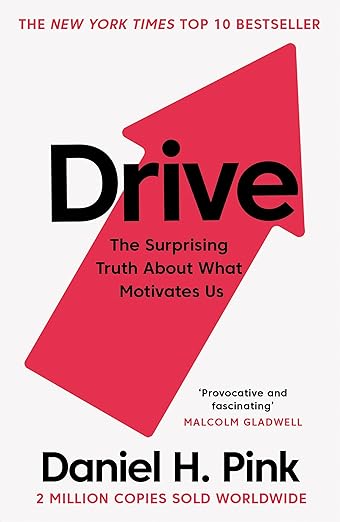


Drive
About Daniel Pink | Daniel Pink
Drive by Daniel H. Pink – Book Overview
Drive by Daniel H. Pink examines what truly motivates people at work and challenges many of the assumptions that underpin traditional performance management, incentives, and reward systems. The book argues that while external rewards such as bonuses, targets, and penalties may work for simple, routine tasks, they are often ineffective or even harmful when applied to complex, creative, or knowledge-based work.
Drawing on decades of behavioural science, psychology, and real-world research, Pink explains that modern performance depends far more on intrinsic motivation than external pressure. He introduces a new framework for understanding motivation that is better aligned with how people actually think, learn, and perform in today’s workplace.
Drive is particularly relevant in environments where innovation, problem-solving, collaboration, and judgment matter. Rather than encouraging leaders to push people harder, the book challenges them to design conditions that allow motivation to emerge naturally and sustainably.
What Is Drive About?
The Core Idea Explained Simply
At its core, Drive is about why people do what they do. Daniel Pink argues that human motivation has evolved, but many organisations continue to rely on outdated models that prioritise control, compliance, and external reward. These models, often referred to as “carrot and stick” approaches, were effective in industrial settings where work was repetitive and outcomes were predictable.
In modern knowledge-based roles, however, the nature of work has changed. Tasks are more complex, outcomes are less certain, and performance depends on creativity, judgment, and learning. Pink explains that in these conditions, external rewards can narrow focus, reduce curiosity, and undermine long-term engagement. Instead of improving performance, they can encourage short-term thinking and risk avoidance.
The book introduces what Pink calls “Motivation 3.0”, a model built on three core drivers: autonomy, mastery, and purpose. Autonomy is the desire to have control over one’s work, including how tasks are approached, how time is used, and how problems are solved. When people feel trusted rather than controlled, they are more likely to take ownership and responsibility.
Mastery reflects the natural human urge to improve, learn, and become competent at something meaningful. High performance is often sustained not by external rewards, but by progress. People are motivated when they can see themselves getting better at work that matters.
Purpose is the sense that work contributes to something larger than individual gain. When people understand why their work matters and how it connects to wider goals, effort becomes more resilient and consistent. Purpose provides context, direction, and meaning, particularly during challenging periods.
Pink also explores the unintended consequences of incentive-heavy systems. He shows how bonuses and targets can distort behaviour, encourage gaming, and reduce ethical standards if not designed carefully. Rather than eliminating rewards entirely, Drive argues for a more thoughtful, limited use of extrinsic motivation, applied only where appropriate.
Ultimately, the book reframes motivation as a design challenge rather than a people problem. When motivation is low, the solution is rarely more pressure. It is better systems, clearer purpose, and greater trust.
Who This Book Is For
Drive is highly relevant for leaders, managers, business owners, and HR professionals responsible for motivating others in modern work environments. It is particularly valuable for those who sense that traditional incentive schemes are no longer delivering the results they once did.
The book is well suited to organisations where performance depends on thinking, creativity, collaboration, and judgment rather than routine execution. Leaders managing professional services, technology teams, sales organisations, or creative functions will find the ideas especially applicable.
Drive is also valuable for individuals who want to understand their own motivation more clearly. Professionals seeking sustained performance, career satisfaction, or deeper engagement with their work can use the book’s principles to reshape how they approach effort, learning, and progress.
Key Principles from Drive
The Main Ideas or Frameworks
The central framework of Drive is built around autonomy, mastery, and purpose. These three elements describe the conditions under which intrinsic motivation thrives.
The book also distinguishes between algorithmic tasks, which follow clear rules, and heuristic tasks, which require experimentation and insight. This distinction helps leaders understand when incentives help and when they hinder performance.
Why These Ideas Matter in Practice
These ideas matter because many organisations unintentionally suppress motivation through excessive control, measurement, and short-term incentives.
In practice, creating conditions that support autonomy, mastery, and purpose leads to higher engagement, better learning, and more sustainable performance over time.
How Drive Applies to Business & Performance
Application in Leadership and Teams
In leadership contexts, Drive encourages a shift away from micromanagement and towards trust-based accountability. Leaders who apply these principles focus on clarity, standards, and ownership rather than constant oversight.
This approach aligns closely with the leadership philosophy described in Turn the Ship Around, where responsibility is pushed to the edges of the organisation.
Teams operating under intrinsic motivation tend to show greater resilience, initiative, and commitment.
Application in Personal Performance and Discipline
At an individual level, Drive encourages people to seek progress and meaning rather than relying on external validation.
This complements the growth-focused mindset explored in Mindset.
When effort is connected to mastery and purpose, consistency becomes easier to sustain.
Practical Examples and Real-World Application
Designing Motivating Work Environments
Organisations apply Drive by offering greater flexibility, encouraging skill development, and clearly communicating purpose.
Leaders reinforce motivation by recognising progress and learning rather than only outcomes.
Overcoming Common Motivation Challenges
A common challenge is over-reliance on incentives to drive behaviour.
The book encourages leaders to redesign systems rather than increase rewards.
Strengths and Limitations of Drive
What the Book Does Well
The book clearly explains why traditional motivation models fail in modern work.
Its research-based approach makes the argument credible and practical.
Where It May Fall Short or Need Supplementing
The book focuses more on motivation than execution.
Pairing it with goal-setting frameworks such as Measure What Matters strengthens accountability.
How Drive Compares to Similar Books
Compared to Grit, Drive focuses more on conditions than perseverance. Compared to Leaders Eat Last, it emphasises motivation design over trust and safety.
Why Business Coaches Recommend Drive
Business coaches recommend Drive because disengagement is often a system issue rather than an attitude problem.
The research supported by Daniel Pink reinforces the importance of intrinsic motivation.
Should You Read Drive?
Quick Decision Summary
This book is ideal for leaders seeking to improve motivation, engagement, and long-term performance.
Drive – Frequently Asked Questions
What is Drive really about?
Drive explains why autonomy, mastery, and purpose motivate people more effectively than rewards or punishment. It shows how motivation must be designed rather than enforced.
Is Drive relevant for business leaders?
Yes. The book helps leaders create environments where people take ownership and perform consistently.
Does Drive reject bonuses entirely?
No. It explains when incentives help and when they undermine performance.
Is Drive research-based?
Yes. It draws on decades of behavioural science and psychology.
Can individuals apply Drive personally?
Yes. Individuals can reshape their work around mastery and purpose.
Is Drive suitable for modern organisations?
Yes. It is particularly relevant for knowledge-based work.
Drive – Key Takeaways
- Motivation is primarily intrinsic.
- Autonomy increases ownership.
- Mastery sustains effort.
- Purpose provides direction.
- Rewards must be used carefully.