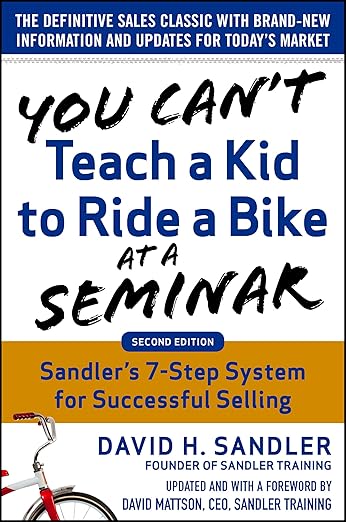


You Can't Teach a Kid to Ride a Bike at a Seminar
David H. Sandler, Founder of Sandler Training & Selling System
You Can’t Teach a Kid to Ride a Bike at a Seminar by David Sandler – Book Overview
You Can’t Teach a Kid to Ride a Bike at a Seminar by David Sandler is a practical and often uncomfortable challenge to how organisations approach learning, training, and performance improvement. The book argues that real capability is not developed through seminars, presentations, or theoretical instruction, but through repeated practice, coaching, and behavioural reinforcement in real working environments.
Using sales as the primary context, Sandler explains why many training programmes fail to produce lasting results. People attend workshops, feel motivated, learn new concepts, and then return to their roles only to revert to old habits within days or weeks. The book explores why this pattern persists and what leaders must do differently if they want learning to translate into sustained performance.
Although the examples are rooted in sales, the underlying message applies to leadership, management, and professional development more broadly. The book is ultimately about behaviour change, accountability, and the discipline required to turn knowledge into consistent execution.
What Is You Can’t Teach a Kid to Ride a Bike at a Seminar About?
The Core Idea Explained Simply
The central idea of the book is simple but confronting: people do not learn new skills by being told what to do. They learn by doing, failing, adjusting, and repeating. David Sandler uses the metaphor of learning to ride a bike to illustrate this point. No amount of explanation, instruction, or theory can substitute for getting on the bike and practising.
In business environments, Sandler argues that training is often treated as an event rather than a process. Organisations bring in trainers, run seminars, distribute materials, and then assume improvement will follow. In reality, without reinforcement, behaviour remains unchanged. Knowledge fades quickly when it is not applied under real conditions.
The book highlights the gap between knowing and doing. Most professionals already understand what good performance looks like. Salespeople know they should ask better questions. Leaders know they should give clearer feedback. Managers know they should hold people accountable. The issue is not awareness, but execution.
Sandler explains that behaviour change requires structured practice. This includes role-play, observation, feedback, and repetition. These activities are often avoided because they feel uncomfortable, time-consuming, or awkward. However, avoiding discomfort also avoids growth.
Another key theme is accountability. Sandler argues that without clear expectations and consequences, people default to familiar habits. Training without accountability creates activity but not improvement. Leaders must actively inspect behaviour, not just results.
The book also challenges leaders to examine their own role in underperformance. When teams fail to improve, the issue is rarely the quality of training alone. It is more often the absence of coaching, follow-up, and reinforcement. Leaders who delegate development entirely to training programmes abdicate responsibility.
Sandler further explains that learning must be embedded into daily routines. Practice should not be reserved for special sessions or annual events. It must be part of meetings, reviews, and everyday work. Only then does behaviour change become normal rather than exceptional.
Ultimately, the book reframes learning as a leadership discipline. Performance improves when leaders create environments where practice is expected, feedback is normal, and accountability is consistent.
Who This Book Is For
This book is highly relevant for sales leaders, managers, coaches, and trainers who are responsible for developing capability rather than simply delivering content. It is particularly valuable for those who feel frustrated by repeated training initiatives that fail to produce lasting change.
The book is also relevant for leaders outside of sales who want learning to translate into execution. Managers responsible for onboarding, performance improvement, or behavioural change will find the principles directly applicable.
Individuals who are serious about improving their own performance will also benefit. The book encourages a shift away from passive learning towards deliberate practice, personal accountability, and consistent self-coaching.
Key Principles from You Can’t Teach a Kid to Ride a Bike at a Seminar
The Main Ideas or Frameworks
The book emphasises practice over theory, coaching over instruction, and accountability over intention. These principles form the foundation of Sandler’s approach to learning.
Role-play, observation, feedback, and reinforcement are presented as non-negotiable elements of skill development.
Why These Ideas Matter in Practice
These ideas matter because performance problems are rarely caused by lack of knowledge. They are caused by inconsistent behaviour.
In practice, organisations that embed coaching and practice into routines see more reliable improvement.
How You Can’t Teach a Kid to Ride a Bike at a Seminar Applies to Business & Performance
Application in Leadership and Teams
In leadership contexts, the book challenges leaders to stop outsourcing development. Capability is built through daily interaction, not occasional events.
This aligns closely with the ownership mindset described in Extreme Ownership, where leaders take responsibility for outcomes.
Teams improve when leaders observe behaviour and intervene consistently.
Application in Personal Performance and Discipline
At an individual level, the book encourages deliberate practice rather than passive consumption of ideas.
This complements the coaching-focused approach in The Coaching Habit.
Skill improves through repetition, not intention.
Practical Examples and Real-World Application
Embedding Practice Into Daily Work
Organisations apply these ideas by building role-play into meetings, reviewing behaviours alongside results, and giving immediate feedback.
Over time, this normalises learning and reduces resistance.
Overcoming Resistance to Practice
A common challenge is discomfort with feedback and role-play.
The book argues that avoiding discomfort delays improvement.
Strengths and Limitations of You Can’t Teach a Kid to Ride a Bike at a Seminar
What the Book Does Well
The book is direct, practical, and uncompromising.
It forces leaders to confront uncomfortable truths about development.
Where It May Fall Short or Need Supplementing
The examples are heavily sales-focused.
Pairing it with broader performance frameworks such as High Performance Habits expands relevance.
How You Can’t Teach a Kid to Ride a Bike at a Seminar Compares to Similar Books
Compared to Atomic Habits, this book focuses more on coaching than self-management. Compared to Drive, it emphasises execution over motivation.
Why Business Coaches Recommend You Can’t Teach a Kid to Ride a Bike at a Seminar
Business coaches recommend this book because it exposes the gap between insight and execution.
The work associated with David Sandler reinforces the importance of practice and accountability.
Should You Read You Can’t Teach a Kid to Ride a Bike at a Seminar?
Quick Decision Summary
This book is ideal for leaders who want learning to translate into measurable performance.
You Can’t Teach a Kid to Ride a Bike at a Seminar – Frequently Asked Questions
What is the main message of the book?
The book argues that skills are built through practice, coaching, and reinforcement rather than explanation or theory alone.
Is this book only relevant to sales?
No. While sales is the primary context, the principles apply to leadership, management, and performance development.
Does the book criticise training?
It criticises training that lacks follow-up, practice, and accountability.
Is coaching essential to the approach?
Yes. Coaching is presented as the mechanism that turns knowledge into behaviour.
Can this book improve team performance?
Yes. Teams improve when behaviour is observed, practiced, and reinforced consistently.
Is this book practical?
Yes. It focuses almost entirely on applied behaviour.
You Can’t Teach a Kid to Ride a Bike at a Seminar – Key Takeaways
- Learning requires practice.
- Knowledge alone does not change behaviour.
- Coaching reinforces skill.
- Accountability drives execution.
- Performance is built daily.