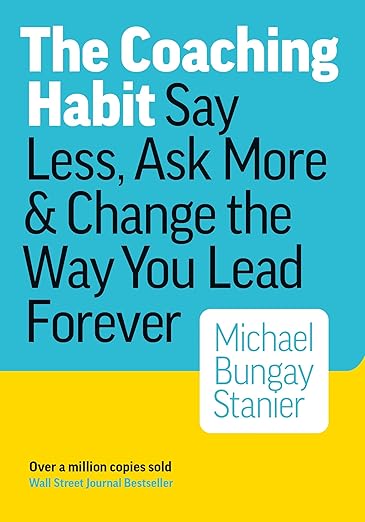


The Coaching Habit
MBS Works | Tools, Books & Ideas powered by curiosity, built for possibility
The Coaching Habit by Michael Bungay Stanier – Book Overview
The Coaching Habit by Michael Bungay Stanier focuses on a deceptively simple but often misunderstood skill in leadership and performance: the ability to coach through conversation rather than control through instruction. The book challenges the default managerial habit of giving advice, solving problems, and stepping in too quickly, arguing instead that sustainable performance is built when leaders help others think for themselves.
In many organisations, managers are promoted because they are capable problem-solvers. Over time, this strength becomes a liability. Leaders become the bottleneck, teams become dependent, and performance suffers. The Coaching Habit addresses this pattern directly, offering a practical framework for replacing advice-giving with curiosity, listening, and better questions.
The book is valued not because it introduces complex theory, but because it simplifies coaching into a repeatable, everyday leadership habit. It is designed for real workplaces, real conversations, and real constraints.
What Is The Coaching Habit About?
The Core Idea Explained Simply
The central idea of The Coaching Habit is that leadership effectiveness improves when managers coach more and advise less. Michael Bungay Stanier argues that most leaders default to what he calls the “advice monster”, the urge to jump in with solutions, opinions, and answers. While this feels helpful in the moment, it often reduces ownership, learning, and accountability over time.
The book reframes coaching not as a formal, time-consuming process, but as a way of showing up differently in everyday conversations. Coaching, in this context, means helping others think clearly about their challenges, options, and responsibilities. Rather than taking control, the leader creates space for insight and decision-making.
Stanier introduces seven core coaching questions that form the backbone of the book. These questions are designed to interrupt automatic advice-giving and replace it with curiosity. Each question has a specific purpose, such as clarifying the real challenge, uncovering assumptions, or identifying what matters most.
A critical insight in the book is that most problems presented to leaders are not the real problems. Employees often bring surface-level issues, while the underlying challenge remains unspoken. Coaching questions help uncover what Stanier calls “the real work” and “the real challenge”, allowing conversations to move beyond symptoms to causes.
The book also addresses the cost of overhelping. When leaders consistently provide answers, they train others to stop thinking independently. This creates dependency, increases workload for managers, and limits team development. Over time, performance plateaus because capability is never fully developed.
The Coaching Habit positions coaching as a performance discipline rather than a soft skill. It argues that better questions lead to better thinking, which leads to better decisions and stronger execution. This makes coaching a practical tool for improving clarity, accountability, and results.
Importantly, the book acknowledges the reality of time pressure. Stanier does not suggest leaders become full-time coaches. Instead, he shows how small conversational shifts can produce disproportionate performance gains.
Ultimately, The Coaching Habit is about changing leadership behaviour at the point where it matters most: in everyday interactions.
Who This Book Is For
This book is highly relevant for managers and leaders who feel overextended, constantly pulled into solving problems that should not sit with them. It speaks directly to those who want stronger teams without becoming the point of failure.
The Coaching Habit is also valuable for leaders who care about developing people, not just delivering short-term results. It provides a framework for building capability while maintaining standards and accountability.
Beyond formal leadership roles, the book is useful for anyone who influences others through conversation, including project leads, senior professionals, and internal advisors.
Key Principles from The Coaching Habit
The Main Ideas or Frameworks
The book is built around seven essential coaching questions, including “What’s on your mind?”, “What’s the real challenge here for you?”, and “What do you want?”. Each question is designed to deepen thinking and shift responsibility back to the individual.
Another key principle is staying curious longer. Leaders are encouraged to delay advice and allow others to explore options before stepping in.
Why These Ideas Matter in Practice
These ideas matter because leadership conversations shape behaviour. When leaders coach effectively, teams take greater ownership and make better decisions.
In practice, coaching improves clarity, engagement, and execution.
How The Coaching Habit Applies to Business & Performance
Application in Leadership and Teams
In leadership contexts, The Coaching Habit encourages leaders to create accountability through questions rather than control. Teams perform better when expectations are clear and ownership is explicit.
This approach aligns closely with the leadership philosophy described in Multipliers, where leaders amplify capability rather than dominate decisions.
Coaching conversations also support trust and psychological safety, which are critical for sustained performance.
Application in Personal Performance and Discipline
At an individual level, the book challenges leaders to manage their own habits first. Resisting the urge to advise requires self-awareness and discipline.
This mindset complements the leadership standards explored in Leaders Eat Last.
Practical Examples and Real-World Application
Using Coaching Questions in Daily Conversations
In practice, leaders apply the coaching habit in short, informal moments rather than formal sessions. Asking one thoughtful question can change the direction of a conversation.
Over time, this builds confidence and capability across the team.
Overcoming the Advice Trap
A common challenge is the belief that leaders must have answers. The book reframes leadership as enabling thinking rather than providing certainty.
This shift reduces dependency and improves long-term performance.
Strengths and Limitations of The Coaching Habit
What the Book Does Well
The book excels in practicality. Its questions are simple, memorable, and easy to apply.
It bridges the gap between theory and action effectively.
Where It May Fall Short or Need Supplementing
The book focuses on conversation rather than broader organisational systems.
Pairing it with goal-setting frameworks such as Measure What Matters strengthens execution.
How The Coaching Habit Compares to Similar Books
Compared to Extreme Ownership, The Coaching Habit focuses less on command and more on curiosity. Compared to Drive, it emphasises behaviour rather than motivation theory.
Why Business Coaches Recommend The Coaching Habit
Business coaches recommend this book because insight without ownership does not change behaviour. Coaching creates clarity while maintaining accountability.
The work associated with Michael Bungay Stanier reinforces the idea that better conversations lead to better performance.
Should You Read The Coaching Habit?
Quick Decision Summary
This book is ideal for leaders who want to develop people without becoming the bottleneck.
The Coaching Habit – Frequently Asked Questions
What is The Coaching Habit really about?
The Coaching Habit is about changing leadership behaviour from advice-giving to curiosity-led conversation. It helps leaders create clarity, ownership, and accountability through better questions rather than control.
Is The Coaching Habit practical for busy leaders?
Yes. The book is designed for short, real-world conversations and does not require formal coaching sessions or significant time investment.
Does this book replace traditional management?
No. It enhances management by improving how conversations support performance and development.
Can coaching work in high-pressure environments?
Yes. Coaching improves thinking under pressure and reduces dependency on leaders.
Is this book suitable for new managers?
Yes. It provides a simple framework for developing leadership capability early.
Does coaching reduce accountability?
No. Coaching strengthens accountability by clarifying ownership and expectations.
The Coaching Habit – Key Takeaways
- Better questions create better performance.
- Advice-giving often reduces ownership.
- Coaching builds capability over time.
- Clarity improves accountability.
- Leadership conversations shape culture.