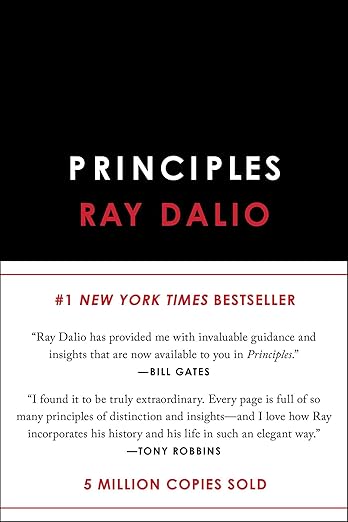


Principles
Ray Dalio - Bridgewater Associates
Principles by Ray Dalio – Book Overview
Principles by Ray Dalio is a detailed exploration of how disciplined thinking, structured decision-making, and radical honesty can be used to improve performance in both business and life. Drawing on decades of experience building and leading Bridgewater Associates, Dalio sets out to document the rules and mental models that helped him navigate complexity, uncertainty, and repeated high-stakes decisions.
The book challenges the belief that success is primarily driven by talent, instinct, or intuition. Instead, it argues that consistent performance comes from understanding how reality works, recognising patterns of cause and effect, and designing principles that guide decisions regardless of emotion or circumstance. In this sense, Principles is less about motivation and more about building systems that produce better outcomes over time.
Dalio positions principles as tools for reducing inconsistency, bias, and emotional reaction. When decisions are made repeatedly under pressure, even experienced leaders fall into predictable traps. Principles offers a way to externalise thinking, making decision-making clearer, more objective, and more repeatable.
What Is Principles About?
The Core Idea Explained Simply
The core idea of Principles is that progress depends on learning from mistakes and systematically improving how decisions are made. Dalio argues that most failures occur not because people lack effort, but because they fail to accurately diagnose problems and apply lessons consistently. Without clear principles, people repeat the same errors, often in slightly different forms, without ever addressing the root cause.
Dalio introduces a simple but demanding process: experience reality, reflect honestly on what happened, identify the cause, design a principle, and apply it going forward. This loop transforms mistakes into learning. The emphasis is not on avoiding failure, but on failing well by extracting maximum insight from every outcome.
A central theme of the book is the importance of radical truth and radical transparency. Dalio argues that progress stalls when people protect ego, avoid conflict, or soften feedback. In organisations where people fear being wrong, decision quality declines because flawed ideas go unchallenged. Radical truth means prioritising accuracy over comfort. Radical transparency means sharing information openly so people can understand context and make better decisions.
The book also addresses how decisions should be made collectively. Dalio introduces believability-weighted decision-making, a process that values open debate while recognising that not all opinions carry equal weight. Experience, track record, and demonstrated understanding matter. This approach avoids both autocracy and consensus-driven paralysis.
Another major component of the book is systems thinking. Dalio repeatedly emphasises that people should not rely on willpower, memory, or intuition alone. Instead, they should design systems that compensate for human weaknesses. Checklists, rules, processes, and feedback loops reduce error and improve consistency.
Principles also explores the relationship between self-awareness and performance. Dalio argues that understanding one’s strengths and weaknesses is essential for growth. Rather than trying to be good at everything, effective leaders surround themselves with people who complement their blind spots and build processes that mitigate personal limitations.
Throughout the book, Dalio reinforces the idea that clarity precedes performance. When people understand how decisions are made, what is valued, and how success is measured, they act with greater confidence and accountability. Without this clarity, effort becomes fragmented and results suffer.
Ultimately, Principles reframes success as the outcome of disciplined thinking applied repeatedly over time, rather than momentary brilliance or inspiration.
Who This Book Is For
This book is particularly relevant for senior leaders, executives, founders, and decision-makers who operate in complex, high-stakes environments. It is well suited to those who must make frequent judgement calls with incomplete information and are accountable for long-term outcomes.
Principles is also valuable for professionals who want to improve their own thinking and decision-making discipline. Its frameworks can be applied at an individual level to reduce bias, improve consistency, and build personal accountability.
People who enjoy structured thinking, reflection, and systems design will gain the most from the book. It is less suited to readers looking for quick motivation and more appropriate for those willing to engage deeply with how they think and decide.
Key Principles from Principles
The Main Ideas or Frameworks
The book introduces several interlocking frameworks, including radical truth, radical transparency, believability-weighted decisions, and systematic learning from mistakes. Dalio also outlines a five-step process for achieving goals that emphasises diagnosis and iteration rather than linear planning.
Another important idea is separating the person from the problem, allowing robust debate without personal conflict.
Why These Ideas Matter in Practice
These ideas matter because poor decisions compound negatively over time.
In practice, clear principles reduce emotional reactions, improve alignment, and support consistent execution.
How Principles Applies to Business & Performance
Application in Leadership and Teams
In leadership contexts, Principles encourages leaders to design environments where truth can surface without fear. Teams perform better when disagreement is welcomed and decisions are grounded in evidence rather than hierarchy.
This emphasis on clarity and transparency aligns closely with the execution discipline described in Measure What Matters, where visibility and review drive performance.
When leaders model openness and reflection, trust increases and learning accelerates.
Application in Personal Performance and Discipline
At an individual level, the book challenges readers to document their own principles. This reduces decision fatigue and improves consistency under pressure.
This complements the habit-building approach explored in Atomic Habits, where systems replace reliance on motivation.
Practical Examples and Real-World Application
Designing Better Decision Systems
Organisations apply these ideas by documenting decision rules, encouraging structured debate, and reviewing outcomes regularly. Mistakes become data rather than sources of blame.
Over time, this creates learning organisations capable of adapting to change.
Reducing Bias and Emotional Decision-Making
A common challenge is ego-driven judgement. Principles encourages separating identity from outcomes to improve objectivity.
This leads to more rational, repeatable decisions.
Strengths and Limitations of Principles
What the Book Does Well
The book offers a comprehensive and rigorous framework for disciplined thinking. Its emphasis on systems over instinct is particularly powerful for complex environments.
Real-world examples reinforce credibility.
Where It May Fall Short or Need Supplementing
The book is demanding and can feel intellectually heavy.
Pairing it with culture-focused frameworks such as The Advantage balances systems with human behaviour.
How Principles Compares to Similar Books
Compared to mindset-focused books, Principles emphasises process and structure. Compared to Good Strategy Bad Strategy, it focuses more on decision quality than strategic diagnosis.
Why Business Coaches Recommend Principles
Business coaches recommend Principles because sustained performance depends on clarity, reflection, and consistency.
The thinking associated with Ray Dalio reinforces the value of disciplined decision-making at scale.
Should You Read Principles?
Quick Decision Summary
This book is ideal for leaders who want to improve decision quality and build repeatable performance systems.
Principles – Frequently Asked Questions
What is Principles really about?
Principles explains how documenting and applying clear decision rules improves judgement, consistency, and long-term performance in both business and life.
Is Principles practical or theoretical?
It is practical, but demanding. The frameworks require reflection and discipline to apply effectively.
Does radical transparency work in real organisations?
When implemented thoughtfully, it improves trust and decision quality.
Is this book suitable for non-financial roles?
Yes. The principles apply broadly to leadership and decision-making.
Can individuals use these ideas personally?
Yes. Personal principles reduce bias and improve consistency.
Is this book challenging to read?
Yes. It rewards careful, deliberate reading.
Principles – Key Takeaways
- Clear principles improve decision quality.
- Truth enables learning and progress.
- Systems reduce bias and error.
- Mistakes are opportunities to learn.
- Consistency drives sustainable performance.