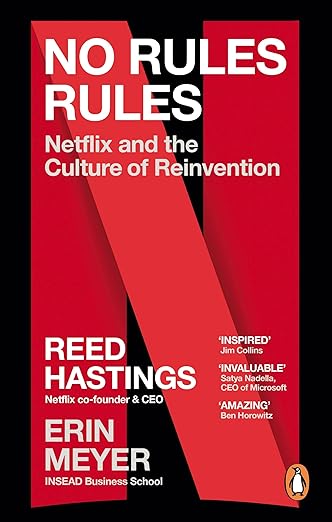


No Rules Rules
Reed Hastings - Netflix
No Rules Rules by Reed Hastings & Erin Meyer – Book Overview
No Rules Rules by Reed Hastings and Erin Meyer explores how Netflix built a high-performance culture by deliberately rejecting many traditional management practices. Instead of relying on rigid rules, detailed policies, and hierarchical control, the organisation focused on talent density, radical candour, and high levels of freedom paired with responsibility.
The book challenges the assumption that rules create safety and consistency. Hastings and Meyer argue that in fast-moving, creative, and competitive environments, excessive rules slow decision-making, reduce accountability, and undermine performance. High-performing organisations, they argue, are built by trusting capable people and holding them to clear standards rather than managing behaviour through policy.
No Rules Rules is particularly relevant for leaders grappling with growth, complexity, and change, where traditional controls struggle to keep pace with the speed of decision-making required.
What Is No Rules Rules About?
The Core Idea Explained Simply
The core idea of No Rules Rules is that the best organisations replace control with context. Reed Hastings argues that when talented people are given clear information, expectations, and accountability, they make better decisions than any rulebook can anticipate. Rules are often created to manage average performance, but they restrict exceptional performance.
The book traces Netflix’s cultural evolution as it grew from a small startup into a global organisation. Early rules that were helpful at a small scale became barriers as the company expanded. Rather than adding more policies, Netflix chose to remove them, provided that talent density and clarity were high.
A central concept in the book is talent density. Hastings argues that a team of highly capable people requires fewer controls. When everyone understands the standards and has the competence to meet them, trust replaces bureaucracy. Conversely, when talent density is low, organisations compensate with rules, approvals, and oversight.
Another key principle is radical candour. Netflix encouraged honest, direct feedback at all levels, including upward feedback to leaders. The goal was not politeness, but improvement. Feedback was framed as a gift that helped people grow and make better decisions. This level of honesty required trust, maturity, and shared commitment to high standards.
The book also explores freedom with responsibility. Employees were given significant autonomy, including policies such as unlimited holiday and minimal expense controls. However, this freedom existed alongside clear expectations. People were expected to act in the company’s best interests, using judgement rather than permission.
Transparency plays a critical role in this model. Netflix shared more information internally than most organisations, including financial data and strategic decisions. This context enabled employees to make informed choices without constant escalation or approval.
No Rules Rules also acknowledges that this culture is demanding. It is not designed for comfort or security, but for performance. People who thrive in such environments value challenge, accountability, and continuous improvement.
Ultimately, the book reframes culture as a performance system built on trust, clarity, and disciplined leadership rather than control.
Who This Book Is For
This book is highly relevant for senior leaders, founders, and executives responsible for shaping organisational culture. It is particularly valuable for those leading fast-growing or innovative organisations where traditional management approaches feel restrictive.
No Rules Rules is also useful for leaders who want to understand the trade-offs involved in high-performance cultures. It does not present Netflix’s approach as universally applicable, but as a deliberate choice aligned to context.
Managers responsible for developing people and making talent decisions will find the book practical, as it addresses hiring, feedback, and performance management in detail.
Key Principles from No Rules Rules
The Main Ideas or Frameworks
The book is built around principles such as talent density, radical candour, freedom with responsibility, and leading with context rather than control. Together, these principles create an environment where capable people can operate with autonomy.
Another key idea is removing rules as the organisation matures, provided standards remain high.
Why These Ideas Matter in Practice
These ideas matter because speed and adaptability are competitive advantages.
In practice, fewer rules enable faster decisions and greater ownership.
How No Rules Rules Applies to Business & Performance
Application in Leadership and Teams
In leadership contexts, No Rules Rules challenges leaders to let go of control while increasing accountability. Leaders must invest more effort in clarity, hiring, and feedback.
This emphasis on standards and ownership aligns closely with the leadership discipline explored in Powerful, where culture is built through decisions rather than policies.
Teams operating with freedom and responsibility demonstrate higher engagement and performance.
Application in Personal Performance and Discipline
At an individual level, the book reinforces the importance of judgement. Freedom requires self-discipline and awareness of impact.
This perspective complements the accountability mindset described in Extreme Ownership.
Practical Examples and Real-World Application
Removing Rules Without Losing Control
Organisations apply these ideas by first raising talent density and clarity before removing controls. Rules are eliminated gradually, not recklessly.
This ensures performance standards are maintained.
Handling Feedback and Performance Conversations
A common challenge is avoiding difficult conversations. No Rules Rules argues that honesty protects trust and performance.
Direct feedback supports continuous improvement.
Strengths and Limitations of No Rules Rules
What the Book Does Well
The book provides a rare, detailed look inside a high-performance culture. Its honesty about trade-offs adds credibility.
Real examples ground the principles in reality.
Where It May Fall Short or Need Supplementing
The approach assumes strong leadership maturity.
Pairing it with alignment-focused frameworks such as The Advantage strengthens cohesion.
How No Rules Rules Compares to Similar Books
Compared to traditional culture books, No Rules Rules is more uncompromising. Compared to Drive, it focuses more on systems than motivation.
Why Business Coaches Recommend No Rules Rules
Business coaches recommend No Rules Rules because it forces leaders to confront the relationship between trust, standards, and performance.
The thinking associated with Reed Hastings highlights how culture choices drive long-term outcomes.
Should You Read No Rules Rules?
Quick Decision Summary
This book is ideal for leaders who want to build high-performance cultures based on trust and accountability rather than control.
No Rules Rules – Frequently Asked Questions
What is No Rules Rules really about?
No Rules Rules explains how Netflix built a culture based on freedom, responsibility, and high standards instead of rigid rules.
Is this approach suitable for all organisations?
No. It works best where talent density and leadership maturity are high.
Does this mean no accountability?
No. Accountability is increased, not reduced.
Is radical candour risky?
When done respectfully, it improves trust and performance.
Does this replace management?
No. It changes how leadership is exercised.
Can traditional organisations adopt these ideas?
Yes, selectively and with discipline.
No Rules Rules – Key Takeaways
- High performance thrives on trust.
- Talent density reduces the need for rules.
- Freedom must be paired with responsibility.
- Honesty supports improvement.
- Leadership behaviour defines culture.