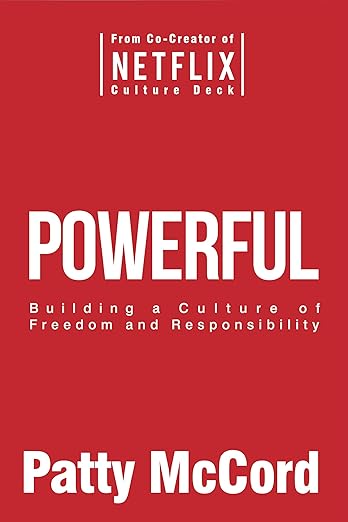


Powerful
Home - Patty McCord
Powerful by Patty McCord – Book Overview
Powerful by Patty McCord challenges many of the most deeply held assumptions about organisational culture, leadership, and people management. Drawing on her experience as Chief Talent Officer at Netflix, McCord argues that high performance is not built through perks, rigid policies, or motivational slogans, but through honesty, trust, high standards, and disciplined leadership.
The book rejects traditional human resources thinking that prioritises retention at all costs, detailed processes, and broad policies designed to manage poor performance. Instead, McCord presents a performance-focused view of culture, one where clarity, accountability, and talent density matter more than comfort or consensus.
Powerful is particularly relevant for leaders who want to build organisations capable of adapting, learning, and performing at a high level without relying on control or bureaucracy.
What Is Powerful About?
The Core Idea Explained Simply
The core idea of Powerful is that the best organisations treat adults like adults and build cultures around performance rather than policy. Patty McCord argues that many traditional management practices are designed to control behaviour rather than enable excellence. Over time, these practices reduce trust, slow decision-making, and limit accountability.
McCord reframes culture as the collective behaviours an organisation tolerates and rewards. In this view, culture is not what is written on the wall, but what happens when pressure is applied. Policies, procedures, and processes matter far less than the decisions leaders make about standards, talent, and honesty.
A central theme of the book is talent density. McCord argues that high-performing teams are composed of capable people who trust one another and hold high standards. When talent density is high, fewer rules are needed because people understand expectations and take responsibility for their work. When talent density is low, organisations compensate by adding rules, approvals, and controls.
The book challenges the idea that loyalty should be rewarded regardless of performance. McCord argues that retaining people who are no longer a good fit damages trust and lowers standards. Instead, she promotes the idea of being fair but honest, even when conversations are difficult.
Another key idea is freedom paired with responsibility. At Netflix, employees were given significant autonomy, but only within the context of clear expectations and accountability. Freedom without standards leads to chaos, while standards without freedom create disengagement. Performance emerges when both exist together.
McCord also addresses the role of transparency. Leaders often withhold information to maintain control or avoid discomfort. Powerful argues that transparency builds trust and improves decision-making, as people are better equipped to act responsibly when they understand the full context.
Throughout the book, McCord emphasises that culture is built through leadership behaviour. What leaders tolerate, excuse, or avoid addressing becomes the true standard. Powerful positions leadership as the work of setting and protecting those standards consistently.
Ultimately, the book reframes organisational culture as a performance system rather than a set of values statements.
Who This Book Is For
This book is highly relevant for senior leaders, executives, and founders responsible for shaping organisational culture. It is particularly valuable for those leading fast-growing, changing, or high-performance environments where traditional policies struggle to keep pace.
Powerful is also useful for managers who find themselves constrained by rules that undermine accountability. It provides a framework for replacing rigid control with clear expectations and trust.
Leaders involved in people strategy, talent decisions, and organisational design will find the book especially practical, as it addresses the real trade-offs involved in performance-focused cultures.
Key Principles from Powerful
The Main Ideas or Frameworks
The book centres on several core principles, including talent density, radical honesty, freedom with responsibility, and context over control. McCord argues that leaders should focus on providing context rather than issuing instructions, allowing capable people to make good decisions.
Another key principle is that policies should be minimal and designed to support performance, not constrain it.
Why These Ideas Matter in Practice
These ideas matter because bureaucracy often grows as a response to mistrust.
In practice, organisations with clear standards and high trust move faster and perform better.
How Powerful Applies to Business & Performance
Application in Leadership and Teams
In leadership contexts, Powerful encourages leaders to prioritise clarity and standards over comfort. Leaders are challenged to make difficult decisions early rather than allow underperformance to persist.
This emphasis on standards and accountability aligns closely with the leadership discipline explored in Extreme Ownership, where responsibility is owned rather than avoided.
Teams operating in high-trust environments demonstrate greater ownership and adaptability.
Application in Personal Performance and Discipline
At an individual level, the book challenges leaders to model the behaviour they expect. Consistency between words and actions reinforces trust.
This complements the culture and leadership perspective outlined in The Advantage.
Practical Examples and Real-World Application
Building High-Performance Cultures
Organisations apply these ideas by clarifying expectations, raising standards, and reducing unnecessary rules. Hiring and performance decisions are aligned with what the organisation truly values.
Over time, this creates cultures where people are trusted and held accountable.
Handling Difficult People Decisions
A common challenge is avoiding difficult conversations. Powerful argues that delaying these decisions erodes trust and damages performance.
Honest, timely conversations protect both people and standards.
Strengths and Limitations of Powerful
What the Book Does Well
The book offers a refreshingly direct perspective on culture and performance. Its emphasis on honesty and standards resonates strongly with experienced leaders.
Real-world examples ground the ideas in practice.
Where It May Fall Short or Need Supplementing
The book assumes a relatively high level of leadership maturity.
Pairing it with coaching-focused approaches such as The Coaching Habit supports capability development.
How Powerful Compares to Similar Books
Compared to Drive, Powerful focuses more on organisational systems than motivation theory. Compared to No Rules Rules, it provides deeper reflection on leadership responsibility.
Why Business Coaches Recommend Powerful
Business coaches recommend Powerful because sustainable performance requires courage, clarity, and consistency.
The thinking associated with Patty McCord reinforces the idea that culture is built through leadership decisions.
Should You Read Powerful?
Quick Decision Summary
This book is ideal for leaders who want to build honest, high-performing cultures without unnecessary bureaucracy.
Powerful – Frequently Asked Questions
What is Powerful really about?
Powerful explains how organisational culture drives performance through trust, high standards, and honest leadership rather than policies and control.
Is this book only relevant to large organisations?
No. Its principles apply to organisations of any size where performance and trust matter.
Does Powerful promote a harsh culture?
No. It promotes fairness, honesty, and respect alongside high standards.
Is this approach suitable for all industries?
Yes. While examples come from technology, the principles are widely applicable.
Does this replace HR processes?
No. It reframes HR as supporting performance rather than managing behaviour.
Can leaders learn this mindset?
Yes. Awareness and discipline enable change.
Powerful – Key Takeaways
- Culture is built through behaviour, not policies.
- High standards protect performance.
- Trust enables autonomy.
- Honesty sustains alignment.
- Leadership decisions define culture.