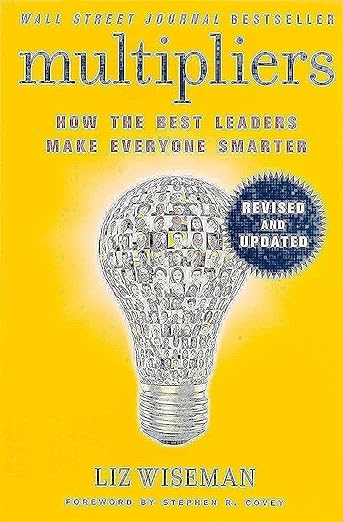


Multipliers
Liz Wiseman's Insights on Leadership | The Wiseman Group
Multipliers by Liz Wiseman – Book Overview
Multipliers by Liz Wiseman explores a powerful idea that challenges traditional leadership assumptions: the best leaders do not add value by being the smartest person in the room, but by amplifying the intelligence and capability of the people around them. The book contrasts two leadership styles, Multipliers and Diminishers, and demonstrates how these approaches dramatically influence performance, engagement, and long-term organisational health.
Rather than focusing on authority, control, or expertise, Wiseman argues that effective leadership is about creating conditions where others can think clearly, contribute fully, and take ownership. Multipliers create environments that demand and develop intelligence, while Diminishers unintentionally suppress it through overcontrol, micromanagement, or the need to be indispensable.
Multipliers is especially relevant in modern organisations where complexity, pace, and knowledge exceed the capacity of any single leader. In these contexts, performance depends less on individual brilliance and more on collective capability.
What Is Multipliers About?
The Core Idea Explained Simply
The core idea of Multipliers is that leadership behaviour directly determines how much intelligence, energy, and capability people bring to their work. Liz Wiseman’s research shows that some leaders consistently get more from their teams, not by pushing harder, but by creating space for others to contribute.
Wiseman identifies two contrasting leadership archetypes. Multipliers are leaders who assume people are capable and intelligent. As a result, they ask better questions, encourage debate, and create accountability without controlling every decision. Diminishers, often unintentionally, operate from the belief that they must provide answers, make decisions, and maintain control to ensure success.
The book explains that Diminisher behaviour is rarely malicious. Many Diminishers are highly capable, well-intentioned leaders who believe their involvement is helpful. However, by jumping in too quickly, correcting too often, or solving problems prematurely, they prevent others from learning, thinking, and owning outcomes.
Multipliers, by contrast, operate differently. They set clear expectations, provide context, and then step back. They allow tension, struggle, and debate to exist long enough for real thinking to occur. Over time, this builds confidence, capability, and accountability across the team.
A key insight of the book is that Multipliers do not abdicate responsibility. They remain accountable for outcomes, but they distribute ownership. This balance between standards and autonomy creates high performance without dependency.
The book also challenges the idea that leadership effectiveness comes from charisma or authority. Instead, it suggests that the most powerful leaders are often those who speak less, listen more, and create conditions where others can excel.
Ultimately, Multipliers reframes leadership as an amplifier role. Leaders either multiply intelligence or diminish it through their behaviour, often without realising the impact they are having.
Who This Book Is For
This book is highly relevant for leaders at all levels, particularly those responsible for developing others. Senior leaders, managers, and team leads will recognise familiar patterns in both Multiplier and Diminisher behaviour.
Multipliers is especially valuable for leaders who feel overloaded or central to every decision. The book offers a pathway to higher performance without burnout by shifting from doing more to enabling more.
It is also useful for high-performing professionals who want to understand how leadership behaviour affects their contribution, engagement, and growth.
Key Principles from Multipliers
The Main Ideas or Frameworks
Wiseman outlines several Multiplier disciplines, including being a talent magnet, creating intensity that requires thinking, extending trust, and holding people accountable for results rather than methods. These behaviours contrast with Diminisher tendencies such as micromanaging, rescuing, and dominating decisions.
The book also introduces the concept of accidental diminishers, highlighting that awareness, not intent, is often the missing ingredient.
Why These Ideas Matter in Practice
These ideas matter because leadership behaviour shapes performance more than strategy alone.
In practice, teams led by Multipliers think more clearly, act with greater ownership, and sustain performance under pressure.
How Multipliers Applies to Business & Performance
Application in Leadership and Teams
In leadership contexts, Multipliers encourages leaders to create clarity around outcomes while allowing flexibility in execution. This reduces dependency and increases accountability.
This approach aligns closely with the leadership standards described in Extreme Ownership, where responsibility is owned but not micromanaged.
Teams led this way develop confidence and capability over time.
Application in Personal Performance and Discipline
At an individual level, the book encourages leaders to examine their own habits and instincts. Resisting the urge to jump in requires discipline.
This self-awareness complements the leadership mindset explored in Leaders Eat Last.
Practical Examples and Real-World Application
Developing Capability Rather Than Dependency
Organisations apply Multiplier principles by pushing decision-making closer to the work and resisting unnecessary escalation.
Leaders focus on asking questions rather than providing answers.
Overcoming Diminisher Tendencies
A common challenge is recognising accidental diminishing behaviour.
The book encourages feedback and reflection.
Strengths and Limitations of Multipliers
What the Book Does Well
Multipliers provides a clear, behaviour-based model for leadership development.
The research-backed contrasts make the concepts easy to recognise and apply.
Where It May Fall Short or Need Supplementing
The book focuses heavily on leadership behaviour rather than organisational systems.
Pairing it with performance frameworks such as Measure What Matters strengthens execution.
How Multipliers Compares to Similar Books
Compared to Drive, Multipliers focuses more on leadership behaviour than motivation. Compared to The Coaching Habit, it addresses broader leadership impact rather than individual conversations.
Why Business Coaches Recommend Multipliers
Business coaches recommend Multipliers because sustainable performance depends on developing people, not controlling them.
The work associated with Liz Wiseman reinforces the importance of multiplying capability rather than bottlenecking decisions.
Should You Read Multipliers?
Quick Decision Summary
This book is ideal for leaders who want higher performance without becoming the point of failure.
Multipliers – Frequently Asked Questions
What is Multipliers really about?
Multipliers is about how leadership behaviour either amplifies or suppresses the intelligence and capability of teams.
Is this book practical?
Yes. It focuses on observable behaviours.
Does it apply to senior leaders?
Yes. Senior leaders have the greatest multiplier effect.
Is it relevant for managers?
Yes. Day-to-day leadership behaviour matters.
Can leaders change from Diminisher to Multiplier?
Yes. Awareness enables change.
Is this suitable for teams?
Yes. Teams benefit when intelligence is multiplied.
Multipliers – Key Takeaways
- Leadership behaviour shapes performance.
- Multipliers amplify intelligence.
- Diminishers suppress capability.
- Accountability does not require control.
- Standards and trust drive results.