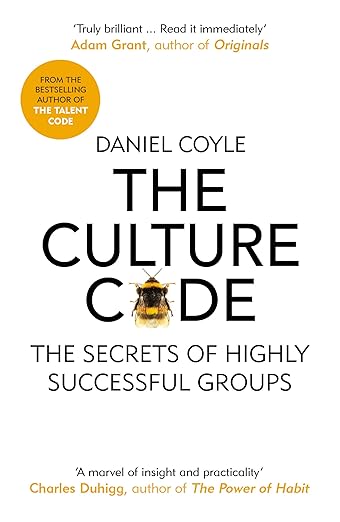


The Culture Code
The Official Site of Bestselling Author Daniel Coyle | The Culture Code
The Culture Code by Daniel Coyle – Book Overview
The Culture Code by Daniel Coyle examines what sits beneath high-performing teams and organisations and explains why culture, not strategy or talent alone, determines sustained success. The book explores how strong cultures are built deliberately through behaviour, environment, and leadership signals rather than slogans, perks, or stated values.
Daniel Coyle draws on extensive research and real-world examples from elite sports teams, military units, creative organisations, and businesses to show that great cultures are not accidental. They are constructed through small, repeatable actions that shape trust, belonging, and shared responsibility over time.
The Culture Code is particularly relevant for leaders who sense that performance problems are rooted not in capability or effort, but in how people interact, communicate, and take responsibility together.
What Is The Culture Code About?
The Core Idea Explained Simply
At its core, The Culture Code is about belonging and behaviour. Daniel Coyle argues that culture is not what leaders say they value, but what people experience day to day. Culture is formed through the signals leaders send, the behaviours they tolerate, and the standards they consistently reinforce.
The book identifies three essential skills that underpin strong cultures: building safety, sharing vulnerability, and establishing purpose. These skills work together to create environments where people feel connected, accountable, and motivated to contribute.
Building safety involves creating a sense of belonging. When people feel safe, included, and respected, they are more willing to speak up, contribute ideas, and take responsibility. Safety is not about comfort; it is about trust. Teams with strong safety communicate more openly and recover from mistakes faster.
Sharing vulnerability is the mechanism through which trust deepens. Coyle explains that high-performing teams are not those where leaders appear infallible, but those where leaders and team members admit uncertainty, ask for help, and learn together. Vulnerability signals invite cooperation rather than competition.
Establishing purpose gives direction to effort. Purpose answers why the work matters and how individual contributions connect to something larger. In strong cultures, purpose is reinforced continuously through language, rituals, and decisions rather than posters on walls.
A key insight of the book is that culture is built through small moments. Simple actions, such as how leaders respond to mistakes, how meetings are run, or how success is recognised, send powerful signals about what is expected and what matters.
The book also challenges the assumption that culture can be fixed quickly. Culture develops through repetition. Leaders who expect instant transformation often undermine credibility by shifting priorities or messaging too frequently.
Ultimately, The Culture Code reframes culture as a practical leadership responsibility rather than an abstract concept.
Who This Book Is For
This book is highly relevant for leaders, managers, and team members responsible for creating environments where people collaborate, perform, and grow together.
It is particularly valuable for organisations experiencing disengagement, silos, or inconsistent standards despite capable people.
Key Principles from The Culture Code
The Main Ideas or Frameworks
The book’s central framework is built around the three skills of culture: safety, vulnerability, and purpose.
Each skill addresses a different human need. Safety satisfies the need to belong, vulnerability builds trust, and purpose aligns effort.
Together, these elements shape behaviour more effectively than rules or incentives alone.
Why These Ideas Matter in Practice
These ideas matter because culture determines how people behave when leaders are not present.
In practice, strong cultures reduce friction, improve accountability, and support consistent performance.
Over time, this creates resilience and adaptability.
How The Culture Code Applies to Business & Performance
Application in Leadership and Teams
In leadership contexts, The Culture Code highlights the importance of behavioural consistency. Leaders shape culture through what they model and what they tolerate.
This aligns closely with the accountability-focused leadership described in Extreme Ownership, where leaders take responsibility for team behaviour and standards.
Teams operating in strong cultures communicate more openly and perform more reliably under pressure.
Application in Personal Performance and Discipline
At an individual level, the book encourages people to contribute to culture through their own behaviour. Small actions, such as offering help, giving honest feedback, or owning mistakes, reinforce trust.
This complements the consistency-driven approach in Atomic Habits, where repeated behaviours shape outcomes.
Individuals who act intentionally strengthen collective performance.
Practical Examples and Real-World Application
Building Culture in a Business Environment
Organisations apply The Culture Code by reinforcing safety through inclusive behaviour, encouraging vulnerability through learning-focused conversations, and clarifying purpose through consistent messaging.
Leaders embed culture by responding predictably to challenges rather than reacting emotionally.
Over time, these practices shape norms and expectations.
Overcoming Common Culture Challenges
A common challenge is assuming culture will fix itself. Without deliberate reinforcement, culture drifts.
The book emphasises the need for ongoing attention and consistency.
Culture improves through leadership discipline, not slogans.
Strengths and Limitations of The Culture Code
What the Book Does Well
The book excels at making culture visible and actionable.
Its use of real-world examples makes abstract ideas concrete.
Where It May Fall Short or Need Supplementing
The book focuses more on behaviour than systems.
Pairing it with strategic clarity such as Playing to Win strengthens organisational alignment.
How The Culture Code Compares to Similar Books
Compared to Leaders Eat Last, The Culture Code is more practical and behaviour-focused. Compared to Good to Great, it addresses the human foundations rather than organisational structure.
Why Business Coaches Recommend The Culture Code
Business coaches recommend this book because culture issues often explain underperformance more accurately than skill gaps.
The work supported by Daniel Coyle reinforces the idea that culture is built deliberately.
When culture improves, performance follows.
Should You Read The Culture Code?
Quick Decision Summary
This book is ideal for leaders seeking to build trust, accountability, and long-term performance.
It may feel subtle for readers expecting quick tactical fixes.
The Culture Code – Frequently Asked Questions
What is The Culture Code really about?
The book explains how strong cultures are built through safety, vulnerability, and purpose. It shows how behaviour shapes trust and performance over time.
Is culture really that important?
Yes. Culture determines how people behave under pressure and when leaders are absent.
Does this book apply to small teams?
Yes. The principles apply at any scale.
Is this book practical?
Yes. It provides clear behavioural guidance.
Can individuals influence culture?
Yes. Individual behaviour contributes to collective norms.
Is this book suitable for leaders?
Yes. It is especially relevant for those shaping team environments.
The Culture Code – Key Takeaways
- Culture is built through behaviour.
- Safety enables performance.
- Vulnerability builds trust.
- Purpose aligns effort.
- Consistency sustains culture.