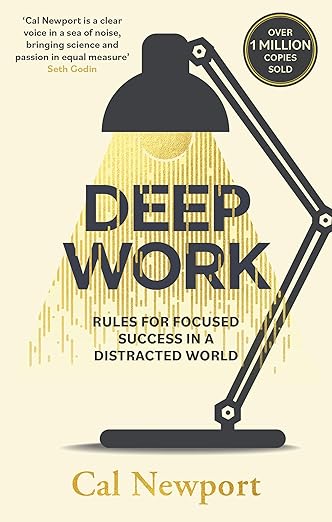


Deep Work
Author of Deep Work, Study Hacks Blog - Cal Newport
Deep Work by Cal Newport – Book Overview
Deep Work by Cal Newport explores the ability to focus without distraction on cognitively demanding tasks and why this skill has become increasingly rare and increasingly valuable in the modern working world. The book argues that deep, focused work is the foundation of high-quality output, learning, and professional mastery, yet it is systematically undermined by constant connectivity, shallow tasks, and reactive working habits.
Cal Newport positions deep work not as a productivity trick, but as a professional discipline. He argues that individuals and organisations that fail to protect focus will struggle to produce meaningful results, regardless of talent or effort. In contrast, those who cultivate deep work habits gain a significant advantage in performance, creativity, and long-term relevance.
The book combines research from psychology and neuroscience with practical observations from knowledge work, making it particularly relevant for leaders, professionals, and anyone whose value depends on thinking, problem-solving, or creating rather than simply reacting.
What Is Deep Work About?
The Core Idea Explained Simply
At its core, Deep Work is about attention. Cal Newport defines deep work as the ability to concentrate fully on a demanding task without distraction. This state allows individuals to learn complex things quickly and produce work of a higher quality than would otherwise be possible.
The book argues that modern work environments actively discourage deep work. Email, instant messaging, meetings, notifications, and open-plan offices fragment attention and reward responsiveness rather than depth. Over time, this creates a culture of shallow work, where people are busy but not effective.
Newport makes a clear distinction between deep work and shallow work. Shallow work consists of logistical tasks, administrative duties, and low-value activities that do not require intense focus. While shallow work is often unavoidable, it should not dominate the working day. When it does, it crowds out the activities that actually drive performance.
A central argument of the book is that deep work is becoming more valuable precisely because it is becoming rarer. As automation, artificial intelligence, and global competition increase, the ability to perform complex, focused work becomes a key differentiator. Those who can master this skill will thrive, while those who cannot will struggle to remain relevant.
Newport also challenges the myth of multitasking. He explains that task-switching degrades performance, increases error rates, and creates mental fatigue. What feels like efficiency is often a hidden drain on cognitive capacity.
The book further argues that deep work is not simply about productivity, but about meaning. People derive greater satisfaction from work that requires effort, mastery, and concentration. Shallow work, by contrast, leaves people feeling drained and unfulfilled.
Importantly, Deep Work does not suggest eliminating shallow tasks entirely. Instead, it encourages intentional structuring of work so that deep tasks are protected, prioritised, and respected.
Ultimately, the book reframes focus as a skill that must be trained deliberately rather than assumed.
Who This Book Is For
This book is highly relevant for professionals, leaders, creatives, and knowledge workers whose effectiveness depends on thinking rather than constant availability.
It is particularly valuable for those who feel busy but struggle to produce meaningful, high-quality output.
Key Principles from Deep Work
The Main Ideas or Frameworks
The book outlines several philosophies of deep work scheduling, including monastic, bimodal, rhythmic, and journalistic approaches. Each provides a way to integrate deep work into different lifestyles and roles.
Newport also introduces the concept of attention residue, explaining how switching tasks leaves part of the mind stuck on the previous activity, reducing performance.
The book emphasises rituals, routines, and environment design as critical supports for sustained focus.
Why These Ideas Matter in Practice
These ideas matter because focus directly affects output quality.
In practice, individuals who protect deep work time produce better results with less wasted effort.
Over time, this builds expertise and professional credibility.
How Deep Work Applies to Business & Performance
Application in Leadership and Teams
In leadership contexts, Deep Work challenges the expectation of constant availability. Leaders who protect focus signal that quality matters more than noise.
This aligns with the clarity and standards described in The Effective Executive, where judgment and contribution matter more than activity.
Teams that respect focus operate with greater intention and fewer errors.
Application in Personal Performance and Discipline
At an individual level, the book encourages deliberate structuring of the day to prioritise meaningful work.
This complements the habit-based discipline described in Atomic Habits.
Consistency in focus compounds into long-term performance gains.
Practical Examples and Real-World Application
Building Deep Work Habits
Individuals apply deep work by scheduling uninterrupted blocks of time, reducing digital distractions, and setting clear boundaries.
Leaders reinforce deep work by respecting focus and reducing unnecessary interruption.
Over time, these habits improve output quality.
Overcoming Common Focus Challenges
A common challenge is the discomfort of sustained concentration.
The book argues that this discomfort is a sign of cognitive growth, not failure.
Training attention improves tolerance for focus.
Strengths and Limitations of Deep Work
What the Book Does Well
The book clearly explains why focus matters and how distraction erodes performance.
Its practical advice makes it applicable across roles.
Where It May Fall Short or Need Supplementing
The book focuses more on individual behaviour than organisational systems.
Pairing it with cultural frameworks such as The Culture Code strengthens application.
How Deep Work Compares to Similar Books
Compared to Atomic Habits, Deep Work focuses on attention rather than behaviour. Compared to Grit, it emphasises quality of effort over sheer persistence.
Why Business Coaches Recommend Deep Work
Business coaches recommend Deep Work because many performance issues stem from fragmentation and overload.
The work supported by Cal Newport reinforces the value of focus as a professional skill.
When focus improves, performance follows.
Should You Read Deep Work?
Quick Decision Summary
This book is ideal for professionals seeking higher-quality output and meaningful work.
It may challenge environments built on constant responsiveness.
Deep Work – Frequently Asked Questions
What is Deep Work really about?
Deep Work is about the ability to focus deeply on demanding tasks. It explains why this skill is increasingly valuable and how distraction undermines performance.
Is Deep Work relevant for leaders?
Yes. Leaders influence whether focus or distraction is rewarded.
Does the book reject technology?
No. It encourages intentional use rather than constant connectivity.
Is Deep Work practical?
Yes. It provides clear strategies for building focus habits.
Can anyone learn deep work?
Yes. Focus is a trainable skill.
Is Deep Work suitable for teams?
Yes. Teams benefit when focus is respected.
Deep Work – Key Takeaways
- Focus is a competitive advantage.
- Deep work drives quality.
- Distraction erodes performance.
- Attention must be trained.
- Meaning comes from mastery.