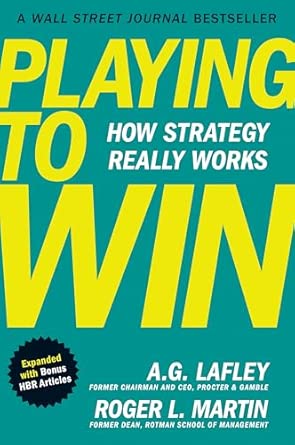


Playing to Win
Home
Playing to Win by A.G. Lafley & Roger L. Martin – Book Overview
Playing to Win by A.G. Lafley & Roger L. Martin is a practical guide to strategy that cuts through jargon and theory to answer a simple but often misunderstood question: what does it actually mean to have a strategy? Rather than treating strategy as long-term planning, vision statements, or abstract ambition, the book frames strategy as a set of clear, integrated choices about how an organisation will compete and win.
Based on Lafley’s experience as CEO of Procter & Gamble and Roger Martin’s work as a strategist and academic, the book translates strategy into a usable discipline. It explains how leaders can move beyond vague aspirations and instead make deliberate decisions about where to play, how to win, and what capabilities are required to succeed.
Playing to Win has become influential because it demystifies strategy. It shows that strategy is not about predicting the future perfectly, but about making coherent choices and committing to them with discipline and clarity.
What Is Playing to Win About?
The Core Idea Explained Simply
At its core, Playing to Win is about choice. The book argues that strategy is fundamentally about deciding what an organisation will and will not do. Without clear choices, organisations drift, spread resources too thinly, and confuse activity with progress.
The authors challenge the idea that strategy is a static plan created once every few years. Instead, they describe strategy as an ongoing, dynamic process that requires leaders to continually reassess assumptions, competitors, and customer needs.
The book introduces a clear strategy cascade made up of five interrelated questions. These questions guide leaders from purpose through to execution and ensure that strategy translates into action.
The first question is about winning aspiration: what does winning mean for this organisation? This forces leaders to define success clearly rather than relying on generic goals.
The second question addresses where to play. Leaders must decide which markets, customer segments, geographies, and categories to focus on. This requires saying no as much as saying yes.
The third question asks how to win. This involves defining the unique value proposition and competitive advantage that will differentiate the organisation.
The final questions focus on capabilities and management systems. These ensure the organisation has the skills, processes, and structures required to execute the strategy consistently.
Together, these choices create coherence. When choices align, execution becomes clearer and performance improves.
Who This Book Is For
This book is particularly valuable for senior leaders, executives, and managers involved in strategic decision-making. It is also useful for consultants and professionals who need a clear language for discussing strategy.
It resonates strongly with leaders frustrated by strategy processes that produce documents but little impact.
Key Principles from Playing to Win
The Main Ideas or Frameworks
The central framework of the book is the strategy cascade. This cascade ensures that high-level ambition translates into specific, actionable choices.
The framework reinforces that strategy is integrated. Choices about where to play affect how to win, which in turn shape capability requirements.
The book also emphasises that strategy requires trade-offs. Attempting to serve everyone usually results in serving no one particularly well.
Why These Ideas Matter in Practice
These ideas matter because many organisations confuse strategy with planning or budgeting.
In practice, clear strategic choices improve focus, resource allocation, and accountability.
Over time, this clarity supports more consistent performance.
How Playing to Win Applies to Business & Performance
Application in Leadership and Teams
In leadership contexts, Playing to Win helps leaders articulate strategy in a way teams can understand. When people know where the organisation is playing and how it intends to win, alignment improves.
This clarity aligns closely with the disciplined focus described in The One Thing, where prioritisation drives execution.
Teams with strategic clarity waste less effort and make better day-to-day decisions.
Application in Personal Performance and Discipline
At an individual level, the book encourages strategic thinking about one’s own role and contribution.
This complements the focus on disciplined execution described in The Effective Executive.
Individuals who apply these principles focus effort where it has the greatest impact.
Practical Examples and Real-World Application
Building Strategic Capability in a Business Environment
Organisations apply the Playing to Win framework by making explicit strategic choices and testing assumptions regularly.
Leaders use the framework to align teams, investment decisions, and performance measures.
Over time, this discipline improves strategic coherence.
Overcoming Common Strategy Challenges
A common challenge is avoiding difficult trade-offs. Leaders may fear excluding options.
The book argues that avoiding choice weakens strategy.
Clear decisions strengthen execution and accountability.
Strengths and Limitations of Playing to Win
What the Book Does Well
The book excels at making strategy practical and accessible.
Its clear language and structured framework support real-world application.
Where It May Fall Short or Need Supplementing
The book focuses on strategic choice more than culture.
Pairing it with culture-focused thinking such as The Culture Code can strengthen implementation.
How Playing to Win Compares to Similar Books
Compared to Good Strategy Bad Strategy, this book is more prescriptive and framework-driven. Compared to Good to Great, it focuses more on strategic choice than organisational transition.
Why Business Coaches Recommend Playing to Win
Business coaches recommend this book because it provides a shared language for strategy.
The thinking promoted by Roger Martin continues to influence modern strategic practice.
When leaders make coherent choices, performance becomes more predictable.
Should You Read Playing to Win?
Quick Decision Summary
This book is ideal for leaders seeking clarity and discipline in strategy.
It may feel demanding for those looking for inspiration without trade-offs.
Playing to Win – Frequently Asked Questions
What is Playing to Win really about?
Playing to Win explains strategy as a set of clear choices about where to compete and how to succeed. It focuses on coherence and execution rather than planning documents.
Is Playing to Win suitable for small businesses?
Yes. The framework applies at any scale and helps smaller organisations focus limited resources effectively.
Does the book provide practical tools?
Yes. The strategy cascade offers a repeatable structure for strategic decision-making.
Is this book academic?
No. It is practical and grounded in real leadership experience.
Can teams use this framework?
Yes. Teams can align priorities and decisions using the cascade.
Is this book useful for consultants?
Yes. It provides a clear language for discussing strategy with clients.
Playing to Win – Key Takeaways
- Strategy is about choice.
- Clarity drives execution.
- Trade-offs strengthen focus.
- Capabilities enable winning.
- Coherent strategy sustains performance.